Can We Create a World of Perfect People?

1363501688_abstract-design-flower-vector-art

Part II

By Jennifer P. Tanabe

JenniferTanabeIn my previous article I asked, “What would a world of perfect people be like? Is it desirable? Would you want to live in it? And is it even possible?” I discussed several possible reactions, and presented the Unification Thought (UT) viewpoint. However, I did not address the big issue of whether it is even possible. Yes, UT presents a positive picture of perfect human beings, but we all know the real world we live in is very far from that ideal.

Why do we have difficulty believing such a world is possible? I think one of the reasons is because of our misunderstanding of what it means to be “perfect,” an issue that was addressed in my first article. Are any of the characteristics of original human nature described in that article impossible to achieve? They are difficult, but not inherently impossible.

Then it comes down to our effort, and overcoming what can be termed our fallen nature, or our tendency to take the easier way instead of challenging ourselves to greater heights in relating to others and in doing good toward others. For example, “I can’t imagine it really” can be translated into “I won’t ever be perfect because I have this and that imperfection which I don’t think I am going to overcome in the foreseeable future, and everyone else I know is like that too.”

Perhaps one way to make perfection seem more attainable is to remember that we don’t have to achieve it in one step. Even in the ideal, with no fallen nature to get in our way, human beings develop through three stages of growth, over a period of say 21 years, to reach maturity. So, it certainly makes sense that as fallen people who face not only the original growing up, in an environment that is far from supportive of the ideal, but also the restoration of all our mistakes and that nourished our fallen nature, we might expect it to take time and to go through a number of steps.
Slide3

Figure 1

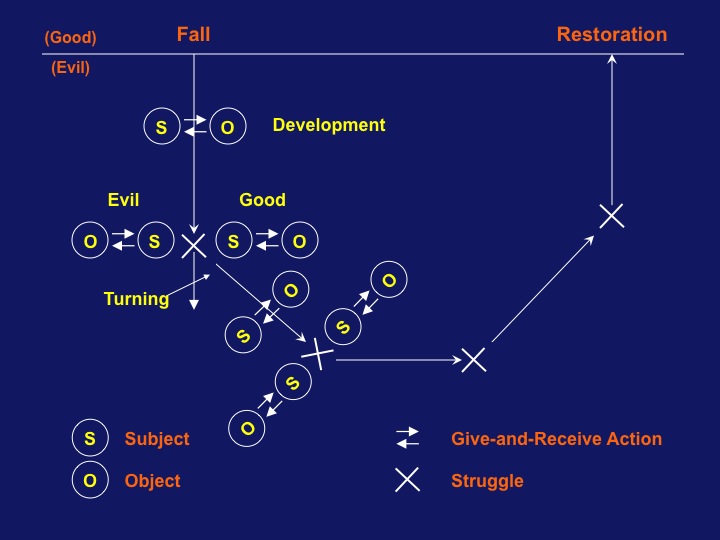
Here I am reminded of the diagram used to describe the “Law of Turning” in the Unification Thought theory of history (see Figure 1). This diagram illustrates how a united subject and object make progress in a particular direction that begins far from, even opposite to, the direction of goodness, but through a series of encounters with other subjects whose purpose and direction is closer to that of God’s, adjustments to the direction are made. Thus the direction of progress turns closer and closer toward being in alignment with goodness.

Continue Reading→

A Unification View on Universal Healthcare

Hands

“Am I my brother’s keeper?” (Gen. 4:9)

by Franco Famularo, UTS Class of 1994

ro.vis1b_3343.famularo.f51Obamacare. Universal healthcare. Private Insurance. Long lines in the U.K. Even longer lines in Canada.  Forty million people without health insurance in the U.S.  Mega-insurance companies fleecing people. Big pharma. Small business owners getting wiped out by medical mishaps.

If you live within earshot of American talk radio or TV news as I do, you will have heard some or all of the above. Discussing universal healthcare in the United States can be most contentious.

European, Canadian, Japanese, Korean, Russian, African, Asian, and American Unificationists will all approach this topic differently. Is there a Unification position on universal healthcare? Do the current systems available to residents of various countries reflect the ideal in any way?

Living a mere 45-minute drive from the Canada-U.S. border has caused me to ponder this topic and I’ll submit my conclusion first.

Neither government-run healthcare nor a system that is privately operated can be trusted to do a good job in providing adequate healthcare within the current circumstances. Human beings still lack the Godly virtues to keep the best interest of the public in mind and fall short, since none has mastered “living for the sake of others.”

The issue is not whether publicly funded or privately run healthcare is better. The problem is the moral and ethical quality of human beings and the solution lies in a moral reformation. When those involved in providing healthcare (government, medical practitioners, administrators, etc.) are comprised of individuals with the highest Godly qualities of the human spirit, an “ideal” health system will emerge.

My interest in the universal healthcare issue was strongly stimulated back in 1993 when UTS classmates Eric Holt, Jerry Chestnut and I took on the challenge at the annual UTS debate of defending Bill Clinton’s proposal to the U.S. Congress.  This helped us to see both sides of the American arguments at the time.

I was born in Canada and have lived here most of my life. For ten years, I spent extensive periods in Germany, the U.K. and the U.S. and was able to observe the various healthcare systems to some degree. They are not all alike.

Last year, some of us listened to presentations under the banner of the “Freedom Society” that addressed the issue to some extent. Proposals were made for a return to the days where churches, charities and families took care of healthcare needs.  I can remember the time before universal healthcare was established in Canada when doctors did house calls and Catholic nuns cared for the sick. I have strong doubts that returning to such a system is plausible. We also heard severe criticism of the U.K. and Canadian healthcare systems. I simply had to laugh as I listened to the ill-informed comments which reflected more the well-known American talk radio show hosts than reality in Canada or the U.K.

Continue Reading→

Religion Is Not the Problem – Worldview Is

worldview11

By Kim Barry

Kim BarryWith Middle East problems again dominating the news, the issue of religion’s role in conflict is hotly debated. The decades-old Israeli-Palestinian conflict is deeply-rooted. We see Shiite and Sunni Muslims fighting and killing one another, and recently, Muslims attacking churches in Egypt, Syria, Libya, and Pakistan, blaming Christians for their countries’ problems.

Atheists use these examples to condemn all religions and belief systems, citing their conviction there is no God to fight over.  The arguments have long ago crossed the borders into the realm of the ridiculous.

Since we have already celebrated Foundation Day, perhaps it is time we re-examine our own worldviews so we can be sure we are creating the best framework for the future.

Mahatma Gandhi had a worldview that was clear and powerful enough to bring the British Empire to its knees. Yet when asked whether or not he was a Hindu, he replied, “Yes, I am. I am also a Muslim, a Christian, a Buddhist, and a Jew.”  His worldview was one of peace and nonviolence, but not appeasement.

Thomas Jefferson made a clear distinction between a person’s religion and worldview, saying:  “It does me no injury for my neighbor to say there are twenty gods or no God,” and yet he also said, “Enlighten the people generally, and tyranny and oppression of body and mind will vanish like evil spirits at the dawn of day.”  The Founding Fathers were extremely diverse in their religious views, but they all united around shared ideals.

One thing I learned long ago is that it’s not a person’s religion that makes them who they are.  It’s something that goes much deeper: worldview, by which I mean how we each see the world and our place in it.

There are the kindest and meanest people within the same religions. The richest and poorest, the most generous and most selfish, the wisest and most ignorant, are all grouped together within the same religion.   If a person’s religion were the same as their worldview, then it would hold that all people within the same religion would behave in a similar manner, making their results similar. But the diverse distinctions mentioned above appear within all religions.  It would be rude or politically incorrect to say that all or most people within a certain religion have any similar traits.

Wikipedia defines worldview as “the fundamental cognitive orientation of an individual or society encompassing the entirety of the individual or society’s knowledge and point-of-view, including natural philosophy; fundamental, existential, and normative postulates; or themes, values, emotions, and ethics.”

Some might argue that worldview is the same as beliefs, therefore, the same as religion. But although one can certainly affect the other, they still remain distinct in the lifestyle and behavior of most people in the world.

Continue Reading→

Using Art and Culture to Effect Change

only_through_beauty_david_eaton_01

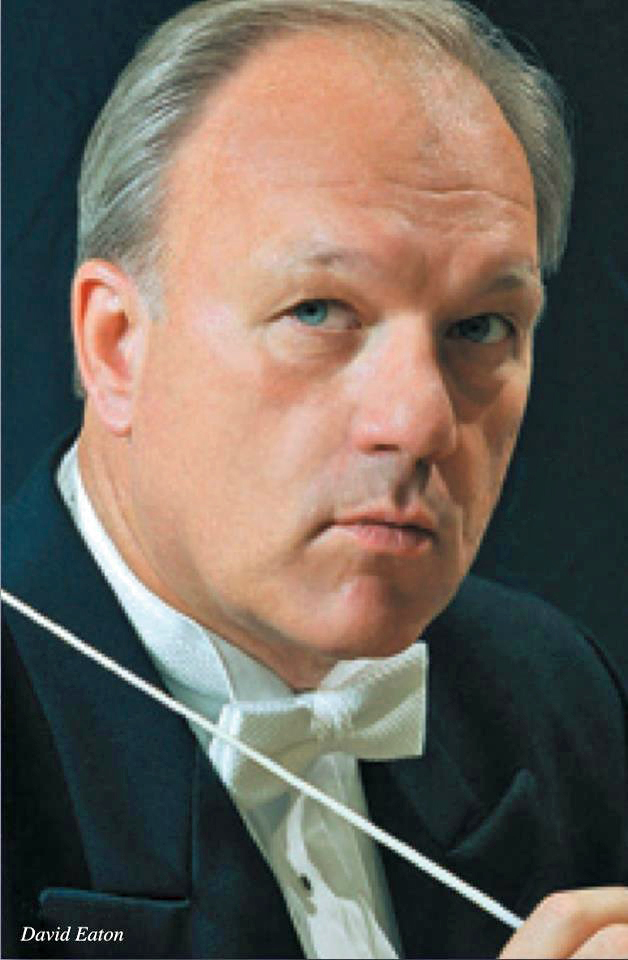
David D’Or and David Eaton share a bow with the Evergreen Symphony Orchestra at the National Concert Hall in Taipei, Taiwan.

By David Eaton, Lecturer in Music and Culture, Barrytown College of UTS

“Only through Beauty’s morning-gate, dost thou penetrate the land of knowledge.”

 – Friedrich Schiller

david_eatonAs an advocate of art and culture, it has always been my view that the beauty aspect of the truth-beauty-goodness paradigm needs to be more fully understood and supported in any attempt to realize a better world. I’ve had many opportunities to use my talent for providential purposes, both within our community and with artists who are not members of our church, and at the heart of my creative endeavors has been my motivation to use my God-given abilities as a musician to promote the ideal of godliness and to cultivate a culture of peace.

Friedrich Schiller (1759-1805), who as a young man possessed a passionate desire to study theology and become a minister, believed that one’s soul state (Seelenzustand) was edified through experiencing beauty. For Schiller, “aesthetic education” could be the basis for a moral society and help establish the freedom that political revolution conspicuously failed to achieve.

I recently returned from conducting two concerts with Israeli vocalist, David D’Or and the Evergreen Symphony Orchestra at the National Concert Hall in Taipei, Taiwan. The concert was produced by the Tzu Chi Foundation, a Buddhist organization founded in 1966 that boasts three million members and scores of chapters throughout the world. Tzu Chi (which means “relief and compassion”) is based in Taipei and has done an amazing amount of humanitarian work, including providing assistance in the aftermath of hurricanes Katrina and Sandy, the Japan tsunami and relief efforts in North Korea. The American chapter of the Tzu Chi Foundation received a national award for being the most outstanding volunteer organization in the U.S. in 2012, due primarily to their relief efforts after Hurricane Sandy.

In addition to running several schools, hospitals and free clinics in Taiwan, Tzu Chi has its own cable television network that broadcasts the news of their global relief efforts as well as programming original content that promotes 24/7 the ideals and vision of their organization. They clearly understand the importance of using mass media and art to get their message to a larger segment of the public

While in Taiwan, I was able to meet the Tzu Chi founder, Master Cheng Yen (a Buddhist nun, now 76) and several of the organization’s key leaders. They explained that music and art are important aspects of their outreach. Their belief in the spiritual power of music plays heavily into their philosophy — and their funding efforts. For the two concerts presented last month I arranged one of the Tzu Chi songs, Family, especially for this occasion.

Continue Reading→

A Unificationist View of Ayn Rand

ayn_rand_1_fs

By Wayne Hankins

HankinsAyn Rand is a writer and philosopher who understood that “something” is terribly wrong with humankind and had the courage to seek the answers to it. Like others before her who tackled this subject, her writings are controversial. For years, I enjoyed her beautiful use of language in expressing her beliefs and telling her stories. She was a powerful and appealing writer. Yet, I now find some of her beliefs very troubling and need to be seriously reevaluated. As a Unificationist, I’ve had to fairly examine her writings, then ask: was her understanding of humankind’s nature correct and is her solution going to solve our dilemma of constant conflict and create a world of goodness and peace?

Ayn Rand, born Alisa Rosenbaum in Russia, was a writer of great passion, whose ideas were born out of the chaos of the Bolshevik Revolution. As a 12-year-old, she saw her nation crumble before her eyes and be recreated under Lenin’s view of how life should be lived. That was Communism. Her father’s business was seized because private property was declared illegal. The state acquired power over the rights of the individual in determining what talents would best serve society. Expressing individualism and self-determination became dangerous, if not illegal, ways to live. Cooperation and collectivism became Russia’s national goals and it was expected everyone would work for the public good, putting the state before self.

To understand Rand’s views of life, one must comprehend the extreme times she lived in. Her philosophy came to be best expressed in The Fountainhead and Atlas Shrugged, her two major works. They are controversial, well read, and now making a comeback, particularly in conservative political ideology.

Her philosophy was expressed by the two main character’s speeches at the climatic moments in each novel. In The Fountainhead, Howard Roark is an architect who, at his trial, defends blowing up the building he designed after his design was altered by a less talented colleague. In Atlas Shrugged, John Galt speaks to a crumbling America from his rundown apartment along the New York waterfront, explaining why the country is in the condition it is, as well as why he persuaded the greatest minds and talents in the nation to abandon a corrupt and dying country in order to save it.

Rand’s stated beliefs are: There is no God. There is only the mind of man and that is supreme. The mind is not a collective or function of the state but an individual attribute. It is our highest value and greatest asset. The most important viewpoint is the individual viewpoint. Only our mind and its proper use can insure our survival. This is the unique creative power of man that no other life form on earth has. A man must think and work alone; the creative process is guided by an individual thought, not a collective brain.

Continue Reading→

Is Evil Necessary?

4money_under_table_vignette

By Tyler Hendricks, Ecclesiastical Endorser, Unification Church of America

tyler_hendricks_edited-1Religion exists to bring about goodness, and yet most religions teach that evil is inevitable and some teach that it is a good thing. Christianity teaches that the human fall was good because it created the need for Jesus. Many follow the position of second century patriarch Irenaeus, who taught that for us to become good, evil has to exist so that we can reject it, or the fourth century patriarch Augustine, who taught that evil is the inevitable price of a greater good, freedom.

The problem is that this leads to the acceptance of evil, an ultimate resignation expressed in common phrases such as “it’s human nature,” “that’s just the way things are,” and “what can you do?” I have two reasons to refute this—and in this essay I will address Irenaeus’ view. One, I believe that a completely good world is possible. Two, I’d like to help Christians appreciate the Divine Principle.

Let’s begin by defining evil. The Divine Principle does not say that selfishness is necessarily evil. Rev. Moon even said that God has an element of selfishness: “All of our human traits originate in God. We recognize that there is some human tendency for selfishness. This is natural because at one time God Himself was self-centered. This fact may surprise you, but you must understand that before God created man and the universe, He was all alone, with no one to care for except Himself. However the very instant that God initiated creation, His full concept of life emerged. God now lives for His counterpart, not for Himself. …He exists to love, He exists to give. God is the totally unselfish existence. …When God poured all of His love, life, and ideal into His second self, He had to, in a sense, realize a profit. God knew that when He invested all He had—100 percent—His object would mature and return to Him many, many times over the fruits of love, life, and His ideal.”

The principled way to fulfill selfish desire, called in the Divine Principle “self-purpose,” is through unselfishness behavior, called “whole purpose.” The important point is that self-purpose gives way to the whole purpose. Goodness means to fulfill selfish desire through unselfish behavior—to put the whole purpose first. This is “principled behavior.” Evil means to fulfill selfish desire through selfish behavior—to put the self-purpose first. This is “unprincipled behavior.” Here, by “behavior” I include both intention and action.

So is evil, that is, unprincipled behavior, necessary so that we can reject it? The answer is, no. The principle is that the subject partner gives to the object partner, which responds to fulfill the purpose of creation. There is no necessity that either partner discontinues the proper behavior or withdraws from the relationship in order for it to succeed. Let’s look at some examples in our everyday experience.

Continue Reading

A Challenge for the Divine Principle in the Postmodern Era

Facebook Connectivity 2010

A 2010 map displaying the connectivity of Facebook’s 1.1 billion global users (click to enlarge).

Keisuke Noda, Professor of Philosophy, Barrytown College of UTS

Keisuke_NodaCan the Divine Principle be attractive to others in the 21st century, or at least for the next 10 or 20 years as our Church’s 2020 goals envision? In Unificationist communities, that question has sparked the development of practical or technological methods of communication/presentation. People have created and re-crafted charts, slides, and PowerPoint presentations and will continue to do so.

The development of these materials is certainly a worthy endeavor, but another way to pose this question is to ask how the Principle answers the questions of the era or the “spirit of the time” (Zeitgeist). Although believers claim that religious teachings reflect truth that is eternal, ideas affirm their validity by responding to the questions of the era. Leading ideas must in fact “lead” the time by demonstrating their validity to people who are desperately trying to find their way. Thus, Unificationists must understand the intellectual climate that we live in if the Principle is to become a leading idea.

During the late 20th century, the United States and other developed countries underwent a major shift rooted in the comprehensive critique of modernity. It is imperative for any intellectual to understand this shift and the intellectual horizons that frame the climate today, known as postmodernism.

What Is Postmodernism?

Postmodernism is a concept that describes a general intellectual stance or tendency towards modernity. As the term post (“after”) modernism indicates, postmodernism is a departure from modernism based on a critical assessment of modernity. It is, in essence, skepticism towards basic assumptions of modernity. Postmodernism is a broad term which encompasses all social cultural spheres including architecture, art, literature, literary criticism, business, management, politics, economics, philosophy, religion, and others. It is a term that can be seen as describing the spirit of the age (Zeitgeist). Postmodernism is distinguished from being just a “trend” because of its lasting and penetrating effects on all spheres of life.

Modernity, as postmodernists see it, is a social, cultural, political wave that lasted for centuries, from the Enlightenment to the late 20th century. Despite the diverse views and ideas encompassed within modernity, modernity was based on certain assumptions that postmodernists later questioned.  Postmodern thinkers have taken a variety of approaches, but the following are a few basic criticisms of modernity by Jean-François Lyotard, a French philosopher.

Continue Reading

What Would a World of Perfect People Be Like?

Bright-flowers-wallpaper-abstract-wallpapers

Part I

By Jennifer P. Tanabe

JenniferTanabeWhat would a world of perfect people be like? Would you want to live in it? And is it even possible? There are several possible reactions to these questions. Let’s consider some of them from the viewpoint of Unification Thought (UT), which answers them in a positive and encouraging way.

The first possible response to the question of what a world of perfect people would be like is: “How boring to have everyone be the same!” Another, “Impossible, only Jesus can be perfect, the rest of us are only human.” A variation from those who do not believe in God might be, “Impossible, only machines are perfect, human beings always make mistakes.” Yet another reaction, “I can’t imagine it really, but I believe that some time in the future that ideal will come.” Not really a resounding affirmation of the possibility of a world of perfect people and how much we would all want to live in it!

How does UT address the idea of human perfection? To start with, UT does assert that human beings can achieve perfection. So that negates the “only machines are perfect” type of response. Let’s look at the various aspects of human perfection from the UT perspective, where it is discussed under the “Theory of the Original Human Nature.” The essential point is that perfection means fulfilling one’s potential in every aspect.

The second reaction I mentioned, the “impossible, we are only human” one, is easily dealt with by explaining the UT perspective on human nature. A perfect human being is who has grown to maturity. Thus, an adult has become a being with all the attributes of original human nature, namely, a being with Divine Image, Divine Character, and Position (see Figure 1). Divine image and divine character: sounds like we will be like God! But, before you go back to the “impossible” reaction, didn’t Jesus say in Matthew 5:48 that we are to be perfect, like God? So if we take Jesus’ words as well as the pledge offered by all blessed families seriously, being truly human means to become divine, God’s true sons and daughters, and thus to be perfect.

Let’s look at the details of this original human nature. First, a being with Position: the point here is that there are always different positions in any relationship, and the ability to recognize one’s position and to relate to the other person from that position appropriately is essential to harmonious and successful human relationships.

Next, Divine Image. This has three aspects: united Sung Sang and Hyung Sang, harmonious Yang and Yin, and individuality. Briefly, united Sung Sang and Hyung Sang refers to a person whose internal character or values (Sung Sang) take priority over physical desires and material life (Hyung Sang).

Continue Reading

Designing and Managing Ethical Organizations

code-of-ethics

By Denis Collins, Professor of Management, Edgewood College

denis127So, you want to create heaven on earth! Unificationists are well aware that people should be at their spiritual best all the time — which means at work too. We spend a great deal of our time on earth working. Some Unificationists have created businesses, some work in church businesses, and others work hard for non-member businesses and organizations.

Unfortunately, work is often organized in a way that is spiritually stifling and degrading. Everyone is morally flawed and, as such, we do things at work that damage, rather than heal and grow, our spirits. For instance, employees are sometimes tempted, or instructed, to mislead customers about product quality, or to treat each other disrespectfully.

Yet business owners and managers possess a unique position to significantly impact the spiritual development of others and, in the process, heal themselves by designing ethical organizations and reinforcing ethical behaviors at work. Unificationists, grounded in church providential theory, should be at the forefront of designing and managing ethical organizations.

How can organizations be designed to maximize ethical behaviors that help people spiritually flourish? This question was one of the reasons why I quit my corporate job in 1978 and joined the Unification Church. It remained on my mind while studying at Unification Theological Seminary from 1980-83, and it has dominated my teaching, writing and research for more than 20 years as a professor of business ethics at the University of Wisconsin-Madison, University of Bridgeport, and now Edgewood College.

I have developed a systematic Optimal Ethics Systems Model based on the 90 best practices in business ethics, sorted into eleven integrated elements. The model begins with determining the ethics of job candidates and then orienting them to the organization’s code of ethics and ethical decision-making process. It recommends conducting ethics and diversity training on at least an annual basis and implementing an ethics reporting system. Managers must model ethical leadership, and work with employees in developing ethical work goals and performance appraisals.

The last three elements of the model include adopting the best practices for environmental management and community outreach, and assessing the performance of each element. By systematically implementing all the Optimal Ethics Systems Model elements, an organization will not only attract employees desiring to experience spiritual transformation through work on a daily basis, but also have in place structures, policies, and processes that will aid employees with their daily spiritual development and engage them in a transcendent vision (An assessment checklist of the 90 best practices is available upon request by emailing the author).

Continue Reading

Website Built with WordPress.com.

Up ↑