“You’re Not Really an Adult Until Your Father Dies”: Reaching the Highest Stage of Filial Piety

By John Redmond

IMG_9544In the current era of the development of our Unification movement, and the primacy of central blessed families, filial piety is an important measure of our behavior and an undeveloped aspect of the Divine Principle.  So what is it and how does it work?

According to Taoism.net:

“Filial piety consists of several factors; the main ideas include loving one’s parents, being respectful, polite, considerate, loyal, helpful, dutiful, and obedient.”

In our American experience, this narrow definition seems like an old-fashioned way of thinking about one’s responsibilities. The Sixth Commandment is “Honor thy father and mother,” but most Christians read that as respect, not worship.  They reserve worship and absolute obedience for the invisible God.

Confucianism does not have the common Judeo-Christian understanding of an invisible personal God. Rather, Confucius emphasized the ethical framework that automatically led to goodness, perhaps the way a good diet automatically leads to a healthy body.  His idea of the “Mandate of Heaven” was meant to occur naturally as people recognized goodness and naturally surrendered to it.

Continue Reading→

The Blind Leading the Blind (or, Life without True Parents)

Detail from “The Blind Leading the Blind” by Sebastian Vrancx.

By Gordon Anderson

Gordon“The blind leading the blind” can be used to describe Western politics and education today. There are, of course, very smart and shrewd politicians or scientists. But, when it comes to knowledge of where we want to go and how to get there, our present culture can be described by this ancient metaphor taught in the Bible, the Upanishads, and Roman classics. As Sextus Empiricus wrote in Outlines of Scepticism: “Nor does the non-expert teach the non-expert — any more than the blind can lead the blind.”

A civilization contains the accumulated experiences of those who have come before, and civilizations continue to adopt new discoveries. However, in the 20th century, the West largely put aside civilizational wisdom, taught by families and religions, and attempted to substitute it with a new-found faith in modern science and the state. The Encyclopedia Britannica exemplified this shift.

Continue Reading→

Time for a New American Unification Renaissance

visits-a-ration-board-1944_edited-1

By John Redmond, Chief Financial Officer, UTS

IMG_9544I remember when we got the direction to return to our “hometowns” and make a tribal messiah foundation.  Looking around the room, one sister spoke for many when she said, “I grew up in five or six towns and my parents were divorced – where do I go?”

America has been the home of the seekers of new opportunity and new adventures since its founding.  Early settlers came for either God or gold, and sometimes both.  The waves of immigration that have filled America with every language and color have been good to America. The bravest and brightest often end up here as opposed to staying in a confined homeland of limited possibilities.

Continue Reading→

Is Russia More Aligned with God’s Will than the United States?

aa_picture_20130917_631451_high-jpg20130920150203

By Michael Mickler, Professor of Church History, UTS

Michael_MicklerAnyone reading the news over past months cannot fail to notice that Russia has asserted itself in significant ways on the world stage. Some of its actions, such as sheltering former NSA computer analyst Edward Snowden, ran counter to American interests and prompted angry protests against America’s surveillance programs. Other actions, such as its intervention in Syria, helped the United States avoid a possible war, at least for the present. This article attempts to sort out these actions and others in light of what Unificationists would interpret as God’s will.

Rev. Sun Myung Moon declared the United States is the “elder son” nation in 1998. Most Unificationists understand this to mean that America is to be a model for the rest of the world, manifesting righteousness, upholding civil and religious liberties, and sacrificing itself or at least serving humanity. These ideals resonate with longstanding views of the United States as a “redeemer nation.”  America was great, Alexis de Tocqueville wrote, “because America is good.”  American democracy was, in Lincoln’s phrase, “the last best hope of earth.” In the 20th century, the U.S. saved the world from the twin evils of fascism and communism. In the process, it became the world’s lone superpower.

The idea of the U.S. as the world’s sole superpower seems almost quaint today, barely more than a decade into the 21st century. China has risen as a formidable competitor, militant Islam is on the march, North Korea regularly threatens the U.S. with nuclear weapons, Syria already unleashed chemical weapons, and America is not yet disengaged from wars of attrition in Iraq and Afghanistan much less from a global war on terror.  Internally, America is divided, mired in a government shut-down and debate over paying its debts. There is little question that Americans feel less secure today than at the turn of the century.

Many factors, both foreign and domestic, have hindered the United States in exercising its “elder son” role. However, two stand out.  First, U.S. leadership, especially since 9/11, has incorrectly interpreted the doctrine of American exceptionalism. Going back to the Puritans, the likening of America to “a city on a hill … a light to the nations” implied that it was the world’s great exemplar, the fullest embodiment of freedom, self-government and the rule of law. However, during the first decade of the 21st century, American exceptionalism has been reinterpreted to mean the United States was “above” or an “exception” to the law, specifically public international law, and privileged to act unilaterally.

Second, Americans have incorrectly interpreted freedom.  Again dating back to the Puritans, U.S. civil liberties have been securely anchored within a compass of moral values and the public good. America was great because she was good. However, in contemporary American society, freedom has come to mean the freedom to do most anything one wants so long as it doesn’t interfere with anyone else’s freedom to do most anything they want. As a consequence, the United States has become identified with moral decadence and individualism.

Continue Reading→

A Unification View on Universal Healthcare

Hands

“Am I my brother’s keeper?” (Gen. 4:9)

by Franco Famularo, UTS Class of 1994

ro.vis1b_3343.famularo.f51Obamacare. Universal healthcare. Private Insurance. Long lines in the U.K. Even longer lines in Canada.  Forty million people without health insurance in the U.S.  Mega-insurance companies fleecing people. Big pharma. Small business owners getting wiped out by medical mishaps.

If you live within earshot of American talk radio or TV news as I do, you will have heard some or all of the above. Discussing universal healthcare in the United States can be most contentious.

European, Canadian, Japanese, Korean, Russian, African, Asian, and American Unificationists will all approach this topic differently. Is there a Unification position on universal healthcare? Do the current systems available to residents of various countries reflect the ideal in any way?

Living a mere 45-minute drive from the Canada-U.S. border has caused me to ponder this topic and I’ll submit my conclusion first.

Neither government-run healthcare nor a system that is privately operated can be trusted to do a good job in providing adequate healthcare within the current circumstances. Human beings still lack the Godly virtues to keep the best interest of the public in mind and fall short, since none has mastered “living for the sake of others.”

The issue is not whether publicly funded or privately run healthcare is better. The problem is the moral and ethical quality of human beings and the solution lies in a moral reformation. When those involved in providing healthcare (government, medical practitioners, administrators, etc.) are comprised of individuals with the highest Godly qualities of the human spirit, an “ideal” health system will emerge.

My interest in the universal healthcare issue was strongly stimulated back in 1993 when UTS classmates Eric Holt, Jerry Chestnut and I took on the challenge at the annual UTS debate of defending Bill Clinton’s proposal to the U.S. Congress.  This helped us to see both sides of the American arguments at the time.

I was born in Canada and have lived here most of my life. For ten years, I spent extensive periods in Germany, the U.K. and the U.S. and was able to observe the various healthcare systems to some degree. They are not all alike.

Last year, some of us listened to presentations under the banner of the “Freedom Society” that addressed the issue to some extent. Proposals were made for a return to the days where churches, charities and families took care of healthcare needs.  I can remember the time before universal healthcare was established in Canada when doctors did house calls and Catholic nuns cared for the sick. I have strong doubts that returning to such a system is plausible. We also heard severe criticism of the U.K. and Canadian healthcare systems. I simply had to laugh as I listened to the ill-informed comments which reflected more the well-known American talk radio show hosts than reality in Canada or the U.K.

Continue Reading→

A Unificationist View of Ayn Rand

ayn_rand_1_fs

By Wayne Hankins

HankinsAyn Rand is a writer and philosopher who understood that “something” is terribly wrong with humankind and had the courage to seek the answers to it. Like others before her who tackled this subject, her writings are controversial. For years, I enjoyed her beautiful use of language in expressing her beliefs and telling her stories. She was a powerful and appealing writer. Yet, I now find some of her beliefs very troubling and need to be seriously reevaluated. As a Unificationist, I’ve had to fairly examine her writings, then ask: was her understanding of humankind’s nature correct and is her solution going to solve our dilemma of constant conflict and create a world of goodness and peace?

Ayn Rand, born Alisa Rosenbaum in Russia, was a writer of great passion, whose ideas were born out of the chaos of the Bolshevik Revolution. As a 12-year-old, she saw her nation crumble before her eyes and be recreated under Lenin’s view of how life should be lived. That was Communism. Her father’s business was seized because private property was declared illegal. The state acquired power over the rights of the individual in determining what talents would best serve society. Expressing individualism and self-determination became dangerous, if not illegal, ways to live. Cooperation and collectivism became Russia’s national goals and it was expected everyone would work for the public good, putting the state before self.

To understand Rand’s views of life, one must comprehend the extreme times she lived in. Her philosophy came to be best expressed in The Fountainhead and Atlas Shrugged, her two major works. They are controversial, well read, and now making a comeback, particularly in conservative political ideology.

Her philosophy was expressed by the two main character’s speeches at the climatic moments in each novel. In The Fountainhead, Howard Roark is an architect who, at his trial, defends blowing up the building he designed after his design was altered by a less talented colleague. In Atlas Shrugged, John Galt speaks to a crumbling America from his rundown apartment along the New York waterfront, explaining why the country is in the condition it is, as well as why he persuaded the greatest minds and talents in the nation to abandon a corrupt and dying country in order to save it.

Rand’s stated beliefs are: There is no God. There is only the mind of man and that is supreme. The mind is not a collective or function of the state but an individual attribute. It is our highest value and greatest asset. The most important viewpoint is the individual viewpoint. Only our mind and its proper use can insure our survival. This is the unique creative power of man that no other life form on earth has. A man must think and work alone; the creative process is guided by an individual thought, not a collective brain.

Continue Reading→

For Peace between Israel and Palestine, Headwing Politics

Netanyahu and Kerry

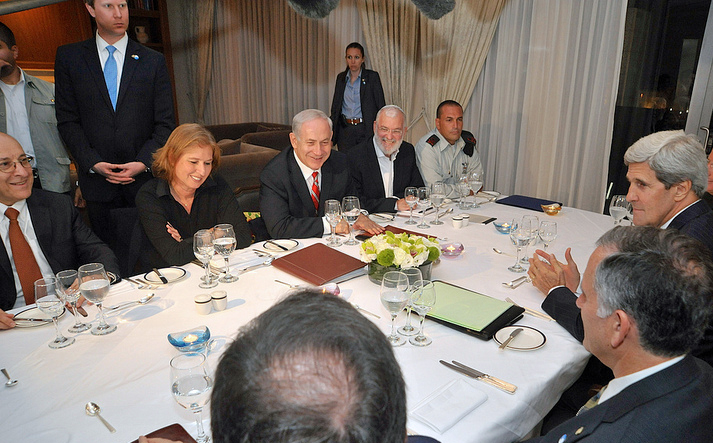
Secretary of State John Kerry (right) sits across from Israeli Prime Minister Benjamin Netanyahu (center), and, to his left, Justice Minister Tzipi Livni, in Jerusalem on June 29.

By Andrew Wilson, Professor of Scriptural Studies, UTS

WilsonThese days Israeli Prime Minister Benjamin Netanyahu is a man caught in the middle. He seems to have come around to the understanding that peace with the Palestinians is a necessity to preserve Israel’s future as a Jewish and democratic state. Yet he is beholden to members of his own Likud party, which includes rightists like Deputy Defense Minister Danny Danon. Danon recently stated on Israeli TV that there would never be a Palestinian state and the Palestinians would be governed by Jordan. Since Netanyahu apparently cannot find enough support for peace negotiations from his own base, if he truly wishes for peace, he has no choice but to reach across the aisle.

Netanyahu governs in a coalition with centrists like Justice Minister Tzipi Livni, an advocate of negotiations, and Finance Minister Yair Lapid, whose party’s surge in the polls early this year came at Likud’s expense. Lapid sees peace with the Palestinians as a desideratum for Israel’s economic future. Yet his coalition also includes Economics Minister Naftali Bennett, whose settler movement seeks permanent Israeli sovereignty over the entire West Bank. In June, he told a settlers group that the idea of a Palestinian state had reached a “dead end.”

And then there is the feisty right wing of Likud led by Danon. At a party nominating convention in May 2012, he organized a group of pro-settler Likud stalwarts to challenge Netanyahu and nearly deprived him of leadership of his own party. Netanyahu was forced to scramble back, which led to his short-lived alliance with Kadima Party leader Shaul Mofaz. Early this month, hardliners gained control of the Likud party. Netanyahu now has to govern with this fragile coalition, making domestic politics an ever-present problem. It goes a long way to explaining his recalcitrance, despite U.S. Secretary of State John Kerry’s five visits to the region since taking office to jumpstart peace talks.

Netanyahu needs to reach across the aisle, to politicians like Shelly Yacimovich, leader of the Labor Party which won 15 seats in January’s election. She is a strong advocate of peace talks, and two months ago met Palestinian President Mahmoud Abbas in Ramallah and told him it is necessary to start peace talks immediately.

This is the nub of the argument I presented in a blog post last month on the website of the World Policy Institute. It is a strictly political argument; what, then, does it have to do with applied Unificationism?

Continue Reading

A Unification Position on Gun Control

AK-47_type_II_Part_DM-ST-89-01131

By Michael Mickler, Professor of Church History, UTS

Michael_MicklerThe Unification movement has an ambivalent relationship to guns and violence. On the one hand, Rev. Sun Myung Moon defined himself a “Peace-Loving Global Citizen,” stated he had tried everything except being a soldier because he never wanted to kill anyone, and dedicated his ministry to the reconciliation of former enemies. On the other hand, at the height of the Cold War, he warned that if “North Korea provokes a war against the South Korean people,” his followers would organize a “Unification Crusade Army” and “take part in the war as a supporting force to defend both Korea and the free world.”

Unification movement-owned factories in Korea manufactured M-1 rifles and the Vulcan Cannon.  During the 1980s, the movement-funded Washington Times supported intermediate-range missiles in Europe, SDI (i.e., the militarization of space), and violent revolt of the Nicaraguan Contras. More recently, Kook Jin Moon, the owner of Kahr Arms, a successful gun manufacturer, claimed, “In the Kingdom of Heaven, all people would…bear arms.” Abel, he said, should never have let himself be killed by Cain but instead used his creativity “to develop a weapon.”

Given its ambivalent relationship to guns and violence, does Unificationism have a word to contribute to the acrimonious and divisive gun control debate in the post-Columbine, post-Virginia Tech, post-Gabby Giffords, post-Aurora, post-Sandy-Hook era?

Some Unificationists maintain there should be no restrictions on gun ownership or usage. In his “Freedom Society” talks, Kook Jin Moon argues that the Swiss militia system best approximates Rev. Moon’s vision of “Peace Kingdom Police.” Everyone has their full-time job and career with all able-bodied male citizens keeping fully automatic firearms at home.

However, it bears mentioning that these arms are government-issued and Swiss citizens are not permitted to keep ammunition for them, it being stored in government arsenals. Until 2007, militia members were allowed a small emergency supply of ammo but it had to be kept in a sealed box and was subject to regular inspections to ensure no unauthorized use had taken place. In 2007, the distribution of ammunition stopped and militia were required to return what ammo they had. Apart from the heavily regulated militia, Swiss gun laws are considered to be restrictive. Gun purchases require a valid weapon acquisition permit and have to be registered.

Continue Reading

Principled Governance or Politics as Usual?

capitol-dome

By Gordon L. Anderson, UTS Class of 1978

GordonUnificationists live in a contemporary culture that champions democracy and instills the idea that politics is about influencing government to provide things or benefits that we desire. Like others in society, Unificationists generally support political parties and special interest lobbies designed to pressure lawmakers into delivering goods and services they believe in.

Politics is War by Other Means

However, “politics” in this sense is the application of “fallen nature” and not of Unificationism. In On War, Carl von Clausewitz described politics as “war by other means.” He meant that people engage in politics to manipulate the government in their fight for control over resources and power, or to gain another benefit for themselves at the expense of society. In this war by other means, people often use the rhetoric of justice and goodness and advocate rectifying the perceived social problem using everyone’s tax dollars. This political behavior is divisive and socially destructive. To the extent Unificationists engage in politics as a form of war, they are at odds with principled governance.

Unificationism is about principles. The main text is the Divine Principle, whose primary hypothesis is that principles underlie the entire created order, and that knowledge of and application of these principles is essential for living a life of happiness. This idea of collective happiness is not unique in political theory. Aristotle began his Politics by stating that the end of politics is human happiness. James Madison, in “Federalist 62,” reaffirmed that the object of government is the happiness of the people. Indeed, Buddha, Confucius, and the founders of the world’s great civilizations sought to explain how people should live and societies be organized in order to be happy.

Principled Governance is the administration of a society to achieve common ends

Any system, whether it is a social institution, the human body, a mechanical machine, an entire social system, or the universe, is governed by principles. When the principles that maintain a system cease to operate, the system breaks down and disintegrates. The design of any system requires knowledge of the purpose for which the system is being created, and the principles necessary for the system to fulfill that purpose.

Continue Reading

Website Built with WordPress.com.

Up ↑