Cain and Abel Children: A Unification Parable

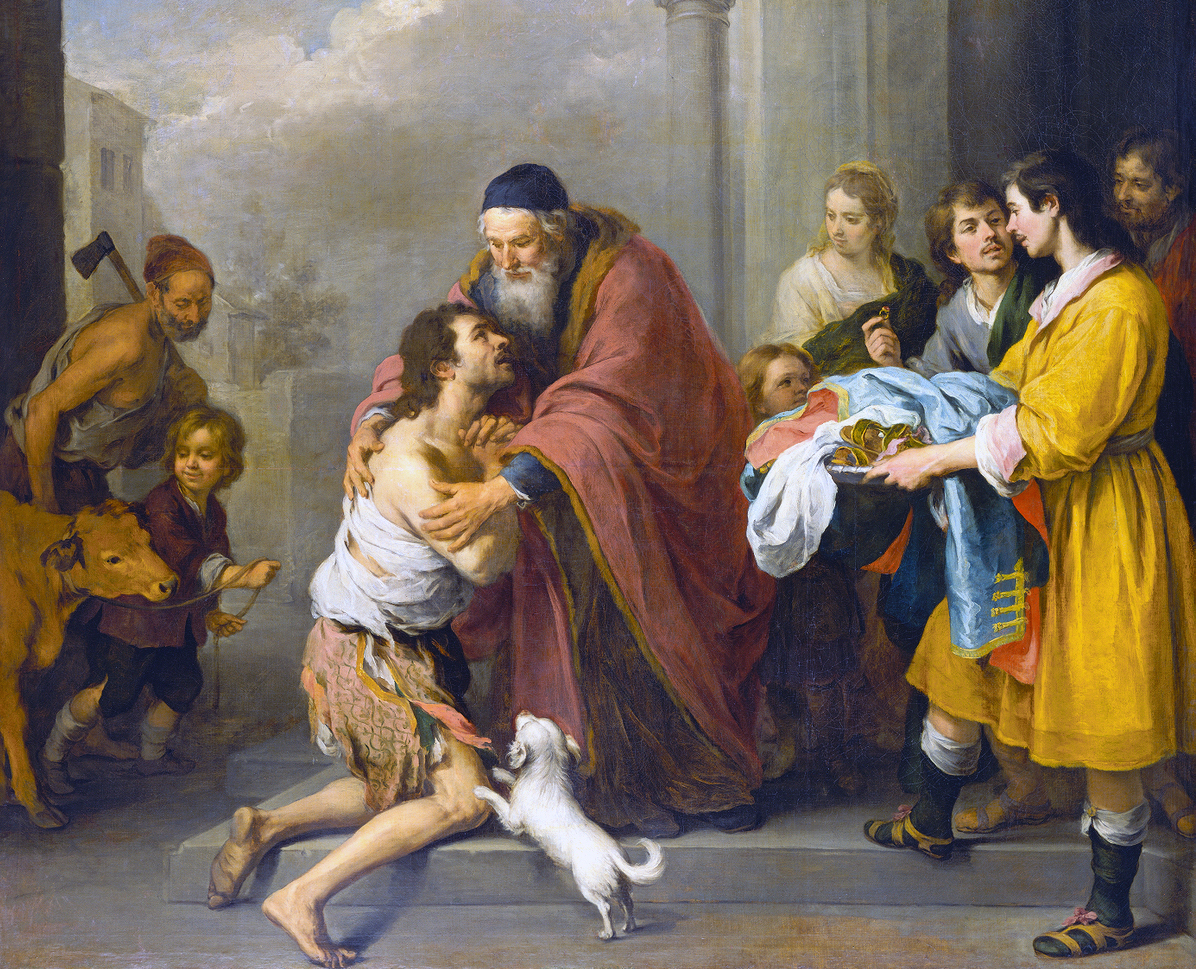
Bartolomé Esteban Murillo, The Return of the Prodigal Son, Spanish, 1617 - 1682, 1667/1670, oil on canvas, Gift of the Avalon Foundation

by Tyler Hendricks

14_12_CfE_Tyler 10.55.08 pmIn the “Cain children” vs. “Abel children” dichotomy, I’m of a mind that the primary category is “children.” Looking at Cain and Abel, the parents would say: “These are all my children. Some are older, some younger, some look more like me, some less, but we are one family and they all receive my inheritance.” Thus I apply the family paradigm from the parents’ viewpoint, rather than as we usually do, from a sibling (rivalry) point of view. I’m also of a mind to bring out the virtues and responsibilities of Cain more than usual.

The parable of the prodigal son (Luke 15:11-32) is instructive. Here, Abel took the inheritance, abandoned his father and wasted it in a self-centered life. But the spark of God within him woke him up; he realized his abject status as a sinner and returned to his father, ready to be a servant of servants. Based on this condition, the father bestowed blessings upon him. On the other hand, Cain served his father faithfully, building up the father’s fortune. He did not share the father’s willingness to bless Abel. But the father reached out to him and told him that all that was the father’s belonged to him and encouraged him to rejoice.

This reminds me of our relationship with True Parents over the years. We Cain children worked so hard, fundraising, witnessing, teaching, sleeping little, having nothing. We in New York would rise well before dawn on Sunday mornings to attend True Father’s sermons at Belvedere, only to get chastised for being sinners. I would think to myself, “But Father, we’re your children who are here attending you! What about those who didn’t even come here?” In the back of my mind was, “Father, you should be praising us, and chastising those who didn’t come.”

I was wise enough to realize a bit of what was going on, and now I’d like to expand upon that. We were True Parents’ Cain children. There’s one important distinction between their Cain children and Abel children: the Cain children were a lot older and so could serve as object partners doing the work with True Parents. We were young to Father, but to the Abel children, the biological children, we were a bunch of old folks running around exhausting ourselves in a missionary life, often joyful, sometimes resentful, but obediently lining up to bow in front of their parents. We had so many complicated feelings toward True Parents, and the Abel children, whose feelings for True Parents were simpler at first, could see it and feel it.


Continue Reading→

Same-Sex Marriage: A Unificationist Response

Gay-marriage-ruling-e1435341862437

By Robert Beebe

Dr BeebeSame-sex marriage is now the law of the land, thanks to the recent 5-4 ruling by the U.S. Supreme Court. Despite 30 states enshrining in their constitutions that marriage was the union of one man and one woman through the combined votes of 50 million people, all this was swept away in two years largely by federal court rulings that made same-sex marriage legal in 37 states, culminating in the Supreme Court decision. Along the way, a majority of Americans are said to now support same-sex marriage. The culture war is over, advocates say. The traditional view of marriage has been cast aside.

All this has occurred not for want of effort on the part of traditional marriage supporters. The National Organization for Marriage, the Family Research Council, and other Christian-based groups have fought tooth-and-nail for many years to prevent what has just happened. Despite their confidence in their cause, and believing that God was on their side, they ended up fighting a losing battle. How did this happen?

Looking back, it seems now an inevitable result of a half-century of cultural change beginning with the sexual revolution of the 1960s. Traditional marriage lost its honored place in American culture long ago when the divorce rate began to skyrocket towards 50%, where it remains today. What are we to expect when millions of children fail to experience the benefits of traditional marriage in their own homes during their formative years? Why should we be surprised when, as teens and young adults, they begin to look elsewhere and experiment in unorthodox ways in their desire to find love? The seeds for legalization of same-sex marriage can be found in the breakdown of the traditional two-parent family.

This has been accompanied by the indoctrination of our young people by a public school system that promotes in the name of diversity not only tolerance but the celebration of all sorts of lifestyles and personal expression. The Judeo-Christian values that once provided the moral foundation for our culture and informed the nation’s education system have been replaced by a godless secular perspective in which anything goes. From this new perspective, once accepted traditional values are now regarded as oppressive and bigoted. Having breathed this atmosphere day-after-day in the public schools, many of our own children have adopted the values of the popular secular culture.

Continue Reading→

The “Invisible Hand” and “Reverse Invisible Hand”

Invisible Hand

by Gordon Anderson

GordonThe economic debates we hear between the right and left today tend to be wars of words based on unscientific suppositions, or statements of faith. Thus, the battles between economic ideologies that often underpin the rhetoric of Republican and Democratic candidates tend to reflect the type of belief we would call “primitive religion” if it were a discussion of some other aspect of human life. Both statements that “an invisible hand of the market can bring happiness to all” and “government redistribution can bring happiness to all” are suppositions that contain an element of magic akin to the common religious belief that “if you are faithful to scripture, God will bless you.”

The Book of Job in the Old Testament is about a faithful man who suffered afflictions, not blessings. The Holocaust is another example of a people faithful to scripture not being protected by their God. Similarly, poverty in the West serves as evidence that a free market economic system does not automatically lead to the happiness of all who live under it. And, the collapse of communism in the USSR is evidence that government allocation of economic resources leads to economic collapse and misery. It is time to move beyond the naïve rhetoric of our inherited economic dogmas and attempt to understand why they rely on a lot of magic and how the scientific study of human economic nature can lead to better solutions.

The Invisible Hand 

In the debates between left and right, free marketers on the right often cite Adam Smith and his “invisible hand” of the market, while socialists on the left consider the invisible hand to be an article of faith. The socialists are right. The term “invisible hand” is a non-scientific name given by Smith to explain a phenomenon he observed. Like the idea “the tree god makes the wind blow,” this type of supposition is a label attached to an observed phenomenon to describe human experience and observation without scientific explanation.

What Smith referred to as the invisible hand has been studied scientifically by psychologists and economists who understand that, in competitive market environments, human beings pursuing their own ends are forced to serve others or starve. In a free market transaction, the seller has to provide something to the buyer that he is willing to pay for, and both buyer and seller “win.”

Continue Reading→

Will We Ever Walk Justly?

Mother Emanuel

By Kathy Winings

kathy-winings-2Headlines across the United States on June 18 blared the news of yet another shooting. The evening before, 21-year-old Dylann Roof walked into the historic Emanuel A.M.E. Church in Charleston, South Carolina, spoke with its pastor, Rev. Clementa Pinckney, and participated in the weekly Bible study that had just begun. Towards the end of the session, Roof rose uttering racist remarks, pulled out a gun and began firing. He killed nine people, including Pinckney; three survived. The shooting has been called a hate crime, and Roof reportedly left a manifesto indicating he wanted to foment a race war.

The shooting is just another example of acts of injustice that haunt us every day. One would think that in the 21st century, amid cries for greater peace and harmony, and with a more educated populace, that incidents of injustice would be lessened and efforts to bring about a more just society would be more successful. Yet we continue to live with a seemingly endless parade of justice issues coming to the fore on a daily basis. We read of religious radicalism and fanaticism, poverty, starvation, human trafficking, global warfare, violence, sexual abuse, racial discrimination, internecine fighting — to name just a few. With all of our knowledge, wisdom, wealth, understanding of history, and our sophistication, why is it still so difficult to achieve a more just and loving world? What are we missing?

As Unificationists, we turn to Unification thought and theology to try to make sense of injustice and to answer the question of what it takes to live justly in the 21st century. However, Unification thought and theology are limited in terms of presenting a practical answer as to why it is so difficult to create a just world. At best, Unification thought and theology use only broad strokes to meet this challenge by presenting theories concerning ontology, original human nature, universal values, ethics, order and equality. Therefore, our challenge is to take these theoretical concepts and develop them to give a more effective practical understanding of how to address injustice.

Continue Reading→

The Misinterpretation of Emperor Constantine’s Vision and Its Consequences

Konstantin's vision

By Rohan Stefan Nandkisore

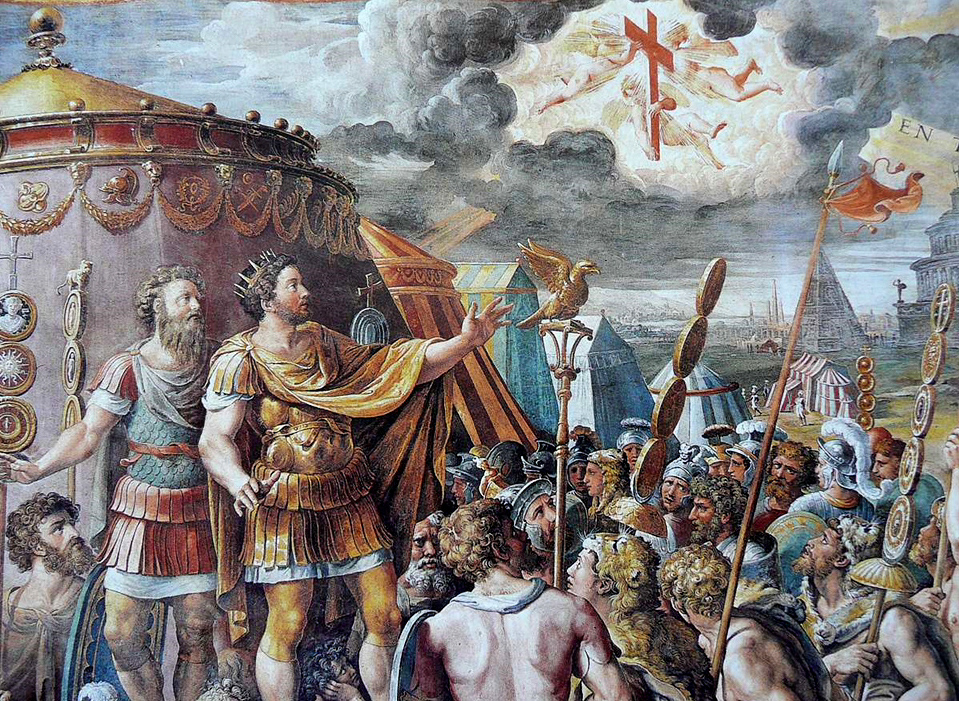
EditorEmperor Constantine’s victory against Maxentius in 312 AD is commonly understood as the first battle under the banner of Christianity and seen as a major shift from its status as a persecuted religion of outlaws to the established power that would reign for over a millennia in the world. But is this really the case?

Emperor Constantine had a vision of a cross in the sky. This was interpreted by his advisors as a divine sign of good fortune in coming battle. The cross as a symbol of power in battle originated here. Until then, the cross and more so, the letter “p,” standing for pax or “peace,” were symbols for Christianity.

In still earlier times, the fish was the secret symbol for Christians. In the Greek language, ichthys was the word for fish. Each letter was the beginning of this message: Iesous Christos theou yios soter, “Jesus Christ, son of God, Savior.”

Until Constantine, bloodshed was not caused by Christians. The idea to shed blood in the name of Christ, in the sense to harm others, was alien and not supported by its founder — quite the contrary. As a result of its way of life, this religion of persecuted outlaws eventually brought the Roman Empire to its knees. It did so without military power but through devotion to Christ and by filling the cup of indemnity until finally released. This was perhaps the most honorable victory in Christian history.

The Vikings and the adaptation of Constantine’s conquest

When Reverend Moon travelled through Europe in 2005 (then banned from the Schengen Area), he strongly addressed the Viking mentality of Europeans. At that time, I did not get it, because by my understanding, the Viking age was between 800 to 1000 AD. However, this applied only to the well-known Viking raids that occurred in Western Europe mainly from Norway. In the eastern part of Europe, Vikings travelled as traders and settlers along the rivers, particularly in Russia, until they met Muslim communities on the shores of the Mediterranean. According to the most prevalent theory, the name of the Rus‍ ’ people is derived from an Old Norse term for “the men who row.”

Continue Reading→

Mormon Lessons for the Unification Church

mormon-church-missionary

By Takayoshi Sugawara

TakaSugawaraThe rise of The Church of Jesus Christ of Latter-day Saints (LDS or Mormon Church) is an incredible story of a persecuted Christian offshoot that has grown to become the most successful, new global religion in the 14 centuries since Islam. It boasts 4.5 million active members worldwide (15 million recorded), and the church itself is estimated to be worth $40 billion. Its membership has included a 2012 U.S. presidential candidate.

All this membership, wealth, and a permanent footing in mainstream consciousness was achieved within a 185 years of its founding. This is a monumental achievement. Rodney Stark, a highly regarded sociologist of religion, declared this ascent to be “one of the great events in the history of religion.”

In contrast, the Holy Spirit Association for the Unification of World Christianity (Unification Church) is a new faith experiencing difficulties in all these areas. Currently, the church finds itself in much turmoil in areas such as finances, leadership and growth. If the Unification Church is to survive and grow, changes need to be implemented.

It is fortunate for the Unification Church that the Latter-day Saints have proved it possible for a new religion to find success globally, bucking declining trends experienced by other Christian sects. Many studies of the Church of the Latter-day Saints have attempted to explain its enviable growth. Let’s consider ways the Unification Church might attempt to replicate its success.

To begin with, the development of the two faiths are strikingly similar. A charismatic leader raised in the Christian faith started a new religion upon experiencing a supernatural vision. After initial growth and success, both their fledgling churches experienced severe persecution from their communities, and the founders were jailed several times during their ministries. And now, the factionalism that Unification Church is experiencing soon after the death of its founder is eerily similar to the “Succession Crisis” experienced by the Mormons following the assassination of its founder.

Continue Reading→

Going Over the Number 70 in Divided Korea

6245-Snap Art

By Mark P. Barry

Mark Barry Photo 2This year marks 70 years since the division of Korea. From August 1945, the Korean Peninsula has been split between a communist North and democratic South. Unificationists know Reverend Moon foretold, exemplified by a 1985 conference, that the Soviet Union would collapse after going over the number 70, figured from 1917. While it took four more years, highlighted by the Soviet experiment with perestroika and glasnost, President Gorbachev resigned and dissolved the USSR on Christmas Day 1991.

With the Unification movement focused on Vision 2020, it begs the question: “Can the Korean Peninsula be reunified by the end of this decade?” or, at least, “Will the two Koreas develop a peaceful and constructive relationship, ending their decades of hostility and division?”

East Asia knows the special significance of 2015. For Korea, China, and Southeast Asia, it is a year to commemorate their liberation from Japanese military occupation. For Korea, 1945 also marked the end of 40 years of Japanese colonial domination and annexation. For Japan, as it has already experienced in recent months, this year has been a painful reminder of its wartime legacy in Asia, and the expectations of its victims of 70 years ago for Japan to sincerely apologize and take responsibility for the profound harm it caused. It’s also a time when East Asia is reacting to China’s bid for regional hegemony, given it recently became the world’s largest economy.

For Koreans north and south, this year also marks the 15th anniversary of the historic summit meeting between the North’s Kim Jong Il and the South’s Kim Dae Jung. Both leaders are no longer alive, but Kim Dae Jung’s widow is expected to make a goodwill visit to Pyongyang later this month to commemorate the June 2000 summit. Sadly, little progress was made between the two Koreas after that first summit, and in particular since 2010, their relations have gone steadily downhill.

The first commemoration of the 70th anniversary of the end of World War II took place May 9 in Moscow, where Russian President Vladimir Putin hosted UN Secretary General Ban Ki-moon, China’s President Xi Jinping, and other world leaders to mark the Allied victory in Europe. Up until the last moment, it was expected that current North Korean leader, Kim Jong Un, would attend; but he canceled his trip.*

Continue Reading→

Saints Behaving Badly: Nothing New

reims-portail_nord-st_calixte_1

by Jim Dougherty

Jim DoughertyIn the midst of struggles, early Puritan minister, Massachusetts Bay Colony political figure and Harvard president Increase Mather famously paraphrased I Cor. 10-13 as “Nothing has befallen you, but what is common to men, yea, and to the best of men.”

As Unificationists face the somewhat ironic spectacle of a movement dedicated to unity struggling to unify, amidst faction, division and strife, it’s important to remember we are not the first to stride, stumble, trip, and crawl down this path, and ask ourselves: “What has befallen us, that is not common to people?” — Nothing.

Most, if not all, of the problems we face are the same as others have faced before us. Those problems should not be dismissed or treated lightly, even if we’ve seen them many times before. Indeed, they should be taken all the more seriously as they have proven to be difficult, in many cases almost impossible, to solve. But neither should we be dismayed by those problems, or draw the false conclusion of discouragement because we still face them. Looking at history and what others have gone through can give us perspective, help us manage our expectations, and encourage us to work steadily on the problems we face with the many solutions at our disposal.

Great examples of historical church figures not always living up to our high expectations are found in Saints Behaving Badly: The Cutthroats, Crooks, Trollops, Con Men, and Devil-Worshippers Who Became Saints (2006) by Thomas J. Craughwell, a respected Catholic newspaper columnist.

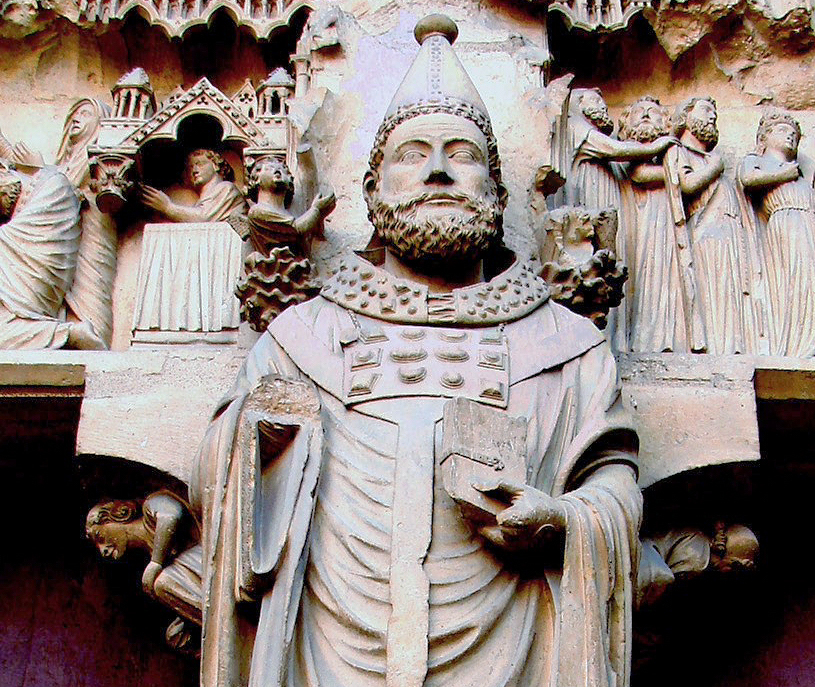
Pope Callixtus I, for example, martyred in 223 CE and canonized, was originally a Christian slave of another Christian, Carpophorus, who had Callixtus set up a bank of sorts for fellow Christians, to protect and invest the savings of widows and orphans, and to collect donations for them. Carpophorus had come to believe that Callixtus was a man of some financial acumen who could handle the job, but it turned out that trust was misplaced. Callixtus succeeded in losing all the money invested, and embezzled some of it in the process. With Roman Christians stripped of their savings and enraged, Callixtus fled to the nearest harbor and booked passage on the first ship he could find.

Continue Reading→

Reconsidering Divine Principle’s Call to Create a Socialist Ideal

Capitalism-Socialism

By Jack LaValley

Jack LaValleyDivine Principle claims the ideals and values embedded in capitalist democratic free markets will give way to a socialist ideal:

“Because human beings are created to live in an ideal society, they will inevitably pursue a socialistic ideal as they strive for freedom and democracy and further search into their original nature (Exposition of the Divine Principle, p. 342).”

Regarding the economic system organized in a socialist society, Divine Principle:

“God’s plan is to develop a socialistic economy, although with a form and content utterly different from the state socialism that communism actually established (p. 341).”

Let’s examine Divine Principle’s call for the creation of a socialist ideal.

In the last 150 years, the Western capitalist system has proved better than any other method devised to produce politically and legally free individuals, distribute products via the free market mechanism and create material prosperity for the individual. In America — still the most prosperous country in the world — people enjoy the freedom to pursue material comfort, a stable democracy, limited government, and peace.

Yet great numbers of individuals in our midst suffer from various forms of mental illness. Available data in the United States on destructive acts such as suicide, homicide, alcoholism, illicit drug use, and a multitude of other psychologically-based disorders, can give us cause to ask if there might be something wrong with our way of life and the aims we are striving for.

Mental health professionals identify three causal factors to mental illness: biological; psychological, and environmental. Outside of genetic factors, brain trauma injuries and neurological disorders, mental illness is often viewed as a deviation from expected social norms and behaviors. Those individuals who break with established social norms and behaviors are viewed as abnormal or mentally ill.

One extreme example of this can be found in the 1970s anti-cult deprogramming phenomenon.

Continue Reading→

Website Built with WordPress.com.

Up ↑