Race, Student Motivation, and the Achievement Gap

elementary-classroom

By Gordon Anderson

GordonIn many policy discussions about the “achievement gap” between whites and minorities in public schools, racism and insufficient public funding of schools are frequently given as the primary reason for the gap. But is blaming race or schools getting to the heart of the achievement gaps that exist today? Or, are social factors related to the motivation and preparation of students more important than either of these policy-driven reasons?

Most public schools are not consciously racist

While some individuals employed by public schools may be racist, and some subconscious racial practices may still exist, racist laws related to segregation and civil rights are largely a thing of the past. Further, the increased diversity and intermarriage in urban American melting pots has tempered old racial stereotypes. Especially, government laws and inner-city school policies have consciously strived to eliminate racism from schools over the last 50 years, and often extra programs are funded to help failing students catch up to others.

Yet, newspapers continue to report that inner-city public schools experience greater delinquency and lower performance among racial minorities. And, for at least the last 30 years, legislators have tried to address the achievement gap by earmarking extra funding for public schools in inner cities. However, performance disparities have not improved; if anything, the “achievement gap” is widening. Are minorities failing because of their race, or are other reasons like socialization of children more important?

Government statistical practices promote racial stereotypes

Social scientists can study whether race, or racism, is the strongest correlate to student failure or whether there are other factors. Because of the tragic history of slavery in the United States, statistics are often promoted racially. When schools report to governments on student achievement, they are asked to do so by race. So charts based on statistics from departments of education get generated like this:

Continue Reading→

Thoughts on Sanctuary Church, Revisited

moon_web_2285_s878x1117

By Tyler Hendricks

14_12_CfE_Tyler 10.55.08 pmMy recent video, “Thoughts on Sanctuary Church,” elicited affirmative responses as well as detailed criticism and ad hominem comments. I’m grateful for it all and want to summarize “Thoughts” and the main criticisms, and respond to the latter.

I began with the logic of Sanctuary’s story, which Dr. Richard Panzer, Sanctuary’s president, affirmed as accurate: True Parents are doing fine; True Parents appoint Hyung Jin Nim’s couple to be their heir; True Father dies and True Mother goes off track; centering on True Father, Hyung Jin Nim’s couple restores True Parents.

I pointed out the error in this logic: If True Mother went off track, then True Parents weren’t really doing fine; if True Parents weren’t really doing fine, the appointment of Hyung Jin Nim’s couple is not valid, which means he’s not the heir of anything.

I understand why some don’t agree with the first point. By “doing fine” I meant the perfection of their marital love as True Parents, from which the Divine Principle says we cannot fall, because to believe otherwise would deny the omnipotence of God, the perfectibility of goodness itself, and the perfection of God (Exposition of the Divine Principle, p. 42). Simply put, true love is eternal, so if True Mother has gone off track, then her love was temporary, and she and True Father did not have true love. This means they weren’t True Parents. True Parents is not people as much as it is a relationship.

I then worked backward from the Sanctuary premise that the appointment is valid. If so, then True Parents were fine; if True Parents were fine, then True Mother was fine; if True Mother was fine, then she would not go off track; if True Mother is not off track, then she is True Parents; if True Mother is True Parents, then Hyung Jin Nim has to attend her; if Hyung Jin Nim is not attending her, then he is off track.

Continue Reading→

Book Review: “The Koreans: Who They Are, What They Want, Where Their Future Lies”

9780312326098

by Mark P. Barry

Mark Barry Photo 2The Koreans: Who They Are, What They Want, Where Their Future Lies, rev. ed., by Michael Breen, New York: Thomas Dunne Books/St. Martin’s Griffin, 2004. Adapted from the Journal of Unification Studies, vol. VI, 2004-2005, pp. 165-68.

Although originally targeted for foreign business readers, Michael Breen’s The Koreans has emerged as a modern-day classic on the Korean character and culture. It is often recommended by Korean studies scholars, alongside such earlier general works as the late Donald S. Macdonald’s Koreans: Contemporary Politics and Society (now in its third edition, revised by Donald Clark). In its 1999 Korean translation from the original 1998 UK edition, The Koreans rocketed to the top ten list of Korea’s bestsellers, revealing Koreans’ own enthusiasm to understand themselves from an outsider’s perspective. The U.S. hardcover edition also appeared in 1999, and the 2004 paperback edition reviewed here is slightly revised with a new chapter on events since 2000.

Breen, a British journalist, originally went to South Korea as The Washington Times’ Seoul correspondent. He ended up living there, during which time he also served for three years as president of the Seoul Foreign Correspondents Club, and wrote for The Guardian and The Times of London. He later became managing director of the Seoul office of public relations firm Merit/Burson-Marsteller, and now runs his own company, Insight Communications Consultants.

Unificationists will remember him authoring in 1997 the meticulously researched Sun Myung Moon: The Early Years, 1920-53, based on in-depth interviews with early followers of Reverend Moon. No book has appeared in English since to rival it.

Continue Reading→

The Long Trek Home: Resolving the European Refugee Crisis

Refugees in Hungary2

by Kathy Winings

kathy-winings-2Thirty thousand, 12,000, 21,000, 3,000, 150,000, 442,000. . . These are just some of the refugee numbers connected with the current humanitarian crisis facing Europe. 30,000 – the number of refugees who have entered Croatia. 12,000 – the number of migrants who have entered Slovenia. 21,000 – the number who have been accepted by Sweden.  3,000 – the number who have drowned at sea while attempting to cross into Europe. 150,000 – the number who made it to Greece. The last number, 442,000 – the number of refugees who have arrived in Europe by boat.

Thousands are continuing to cross borders into Europe on a daily basis. Germany expects 800,000 migrants to reach its borders by year’s end. Each number represents a hope,  dream and vision for a better life, one safe from physical and emotional violence.  Even the United States is considering raising its annual ceiling of 70,000, the total number of refugees it accepts on an annual basis, to 85,000 in 2016 and 100,000 in 2017.  But that is a drop in the bucket compared with the vast numbers of men, women and children fleeing to Europe from Syria, Iraq, Libya, Sudan, Eritrea, Nigeria, Afghanistan, Pakistan and elsewhere for a better life.

This is being hailed as a “humanitarian crisis of epic proportions.” What does it represent? What are the issues involved? Can it be effectively resolved? We have seen mass migrations before; what makes this one different?

First, this migration is occurring in the 21st century. It means more communication is taking place among the migrants by cellphones. As families and groups of migrants move, they are in constant contact with those who have gone before them, learning where to go, what to avoid and what to expect on the road ahead of them. Digital technology also gives them access to GPS, web maps and news.

Second, the reasons why people are migrating are diverse. Previous migrations were often defined by major or cataclysmic events such as war, devastating natural disasters or religious/cultural upheavals. This resulted in mass migrations defined by singular issues.

Continue Reading→

Let’s Start Selling the First Blessing Again

1302885286

By Graham Simon

gs-1308Running a successful business is not easy. Statistics show that 50% of new businesses fail within the first five years. Companies wishing to survive in a competitive marketplace have to ask themselves such basic questions as:

  • Are the management, organization and financing of the company fit for purpose?
  • How can we best market our product or service?
  • Has the sales force sampled the product or service and are they sufficiently motivated to go out and sell it?
  • How great is the demand for the product or service we are offering?

While a spiritual organization may be very different from a firm, there are many parallels too. Any spiritual organization that seeks to grow through proselytizing can usefully look at itself and ask these same four questions. This approach is particularly pertinent when attempting to discover why the Unification Movement has failed to grow in the West over the past quarter century.

Let us address each question in turn.

Are the management, organization and financing of the movement fit for purpose?

In the U.S. and UK of late, a lot of change has occurred in the management, organization and financing of the FFWPU. In the UK, the FFWPU is constituted as a charity. The trustees of the charity have successfully turned around the finances of the movement over the last five years. Last month, the membership was presented with a detailed proposal, which had been more than nine months in the making, for the restructuring of the UK movement. The proposal sets out a plan for improving both the operational management of the charity and fulfilment of its providential aspirations. However, while all of this is important, it is not essential to the expansion of the Providence, because if any one of us is truly motivated, we are quite at liberty to franchise the “product” that the FFWPU is offering and sell it ourselves. We call the franchise tribal messiahship.

Continue Reading→

Into the Future: Why We Need to Create an Alternative Service

Harvest

By Jack LaValley

Jack LaValleyIs it possible our current Sunday service is lacking some core elements of persuasion and conviction that speak to the heart of our need for rebirth and salvation?  Are few new people joining our movement through our Sunday service because we don’t offer them what they really need, when they do show up?  If so, what can we do about it?  A specific kind of alternative service can help us attract and hold more “first-timers” and bring spiritual renewal and revival to our ranks.

Robin Debacker conducted a survey that gathered information from Unificationists about their Sunday service experiences. Contacting individuals via private Facebook messages, she collected 350 responses over a four-month period — two-thirds from the 50+ age group, and 103 from second gen.  Responses came from 195 cities around the world — 38 states in the U.S. and 32 countries.  In summer 2014, the survey results were discussed on this Blog and presented on her website dedicated to that project. Key facts gleaned from her survey were:

  • Nearly 25% of those surveyed do not attend a Unification service, and have distanced themselves or dropped out entirely.
  • 70% of those who indicated they attend a service on a regular basis said they are not inspired, and do so out of a sense of duty, or for social reasons only.
  • The majority of second gen respondents said that most of their second gen friends are not interested and do not attend a Unificationist service. Of those who do attend, many said they are searching for more open and honest discussion, more practical application, and more second gen leadership.

The Sunday service program model still remains the primary weekly gathering in the Unificationist faith community. Yet that model has failed to be the gateway program to persuade and convict the “unchurched” and “spiritual” seekers to become intimately involved with our faith community. Some  have “joined” through Sunday service, but not that many.  In some areas, efforts have been made to use home church, tribal messiahship or small group models to address how to “bring non-Unificationists into the fold,” but such efforts have yet to gain the prestige or influence of Sunday service.

Continue Reading→

Evangelical, Congregational and Blessed

TF speaks outside 1960

By Tyler Hendricks

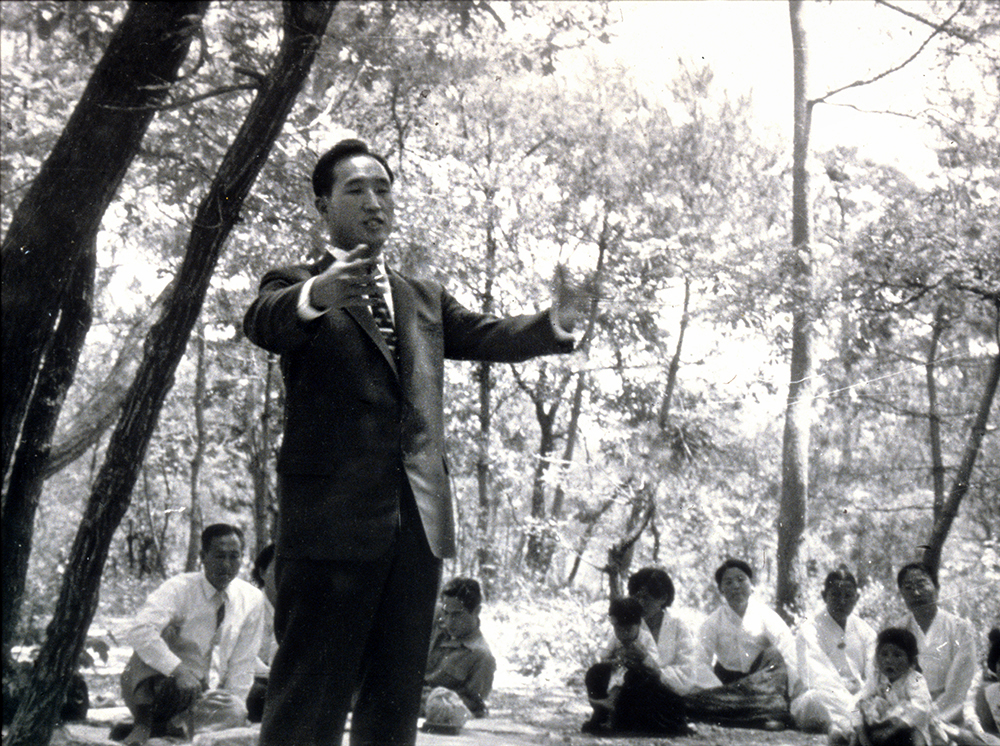
14_12_CfE_Tyler 10.55.08 pmOur Unification movement exemplifies two church models, and serves as a case study of their effect on church growth. Church growth has regular causes that can be discerned by examining churches that are growing. Church decline also has regular causes that can be discerned by examining churches that are shrinking. The defining characteristic of most growing churches is that they have one mission, that being evangelism, and congregational polity. Most shrinking churches have multiple missions and hierarchical polity.

For a church to have an evangelical mission means the church is organized to proclaim the good news (the “evangel”) and to bring others to salvation through it. Congregational polity means that the members of the local church own and govern the local church.

To have a hierarchical polity means that pastors are employed and directed by a central authority. Through the pastors, the central authority, which owns all properties, guides the planning, schedule, strategies, style, etc., for each congregation. Such churches tend to have multiple missions and pay little attention to evangelism.

Thesis #1: The Unification Church grew when and where it had an evangelical mission and congregational polity

Founding of the church: The Unification Church grew from one spirit-led man starting a local congregation. The church had an evangelical mission and congregational polity. He taught and preached a God-centered biblical vision for world transformation. He prayed incessantly. His mission began with a vision of Jesus; people who joined testified that it was the spirit world that led them to him. He loved and served others to bring them into his church, sleeping and eating little, giving up his family, worrying not about physical needs. That was how it started.

Continue Reading→

Good Leadership and Good Management: Why, How, What

8725865766_d7854991bc_k

By John Redmond

JohnRedmond2One of the great ironies of many successful religious movements is that they almost always start from failure — from a secular and mainstream point of view.  Christianity had its charismatic young leader crucified as a rabble rouser for tipping over the tables in the temple. Christians spent years in intellectual gymnastics explaining how the messiah was born an illegitimate child and killed as a criminal.

The Pilgrim Fathers were driven out of England, as were many of the other colonists who settled in the New World.  The Latter Day Saints (Mormons) were driven westward to the American desert to die, their founder lynched and religion mocked.

Yet these movements found multi-generational success in preaching, modeling and promoting the values and doctrines that gave them fulfillment and improved the culture around them.

This doesn’t happen by accident.  Successfully attracting and maintaining believers over multiple generations and changing the values of a culture requires a combination of good leadership and good management, and they are not the same thing.

Leadership requires communicating and validating a shared vision to a group of people you may or may not control. Reverend Moon could cast that vision, and many people, even those uncomfortable with his management style, could agree with that large and inclusive ideal and, perhaps more importantly, sense the heart behind it.

Management is the control of money, processes and people to achieve a desired product or outcome.  I’ve never been impressed with many Unification managers, who mostly mean well, but have little success or training from the real world on which to base their decisions.  They mostly default to Theory X management, micro-managing the behavior of their members rather than nurturing their goals, activities and creativity — or they swing to the other side, to religious-based trust and out-of-control management systems.  A movement with a great vision but poor management may succeed, but its progress is measured in millennia rather than years.

Continue Reading→

How America Can Help Reunite the Korean Peninsula

True Parents Kim

By Mark P. Barry

Mark Barry Photo 2In May, Mrs. Hak Ja Han Moon, speaking in New York, asked America to fulfill its role to help reunite the Korean Peninsula. She said:

…[T]he United States needs to fulfill its responsibility. In order to do so, Korea and the Korean Peninsula needs to become the top issue for the United States. …The homeland of God, Korea, needs to become one nation. And I hope the United States will stand on the forefront of this great task.

Now is the best opportunity yet for the U.S. to take forward-looking steps to make a breakthrough in Korea. August 15 is the 70th anniversary of Korean independence — and of the division of Korea, for which America bears a great share of responsibility. It is clear no other nation can make the difference in bringing about reunification.

Last month, the U.S. reestablished diplomatic relations with Cuba which were frozen in the Cold War since 1961. It also reached a nuclear agreement with another long-standing enemy, Iran, with the hope it will lead to an evolution in Iranian behavior. Now is the time for America to encourage, with seriousness and focus, the two Koreas and the regional powers — Japan, China and Russia — to establish permanent peace in the Peninsula.

On July 27, the three Korean War veterans in Congress, Rep. Charles Rangel, Rep. John Conyers, and Rep. Sam Johnson, introduced legislation calling for a formal end to the Korean War. As I wrote two years ago on this blog, a peace treaty is necessary to end the 1950-53 Korean War, and is the requisite first step toward eventual reunification. Little has changed since I wrote those words. But the opportunity for the American President to take bold actions in his final year and a half in office should not be missed.

Continue Reading→

Website Built with WordPress.com.

Up ↑