A European Earthquake of Epic Proportions

united kingdom exit from europe relative image

By Graham Simon

gs-1308On June 23, Britain held a referendum in which the public voted whether to remain part of the European Union (EU) or leave. While 48.1% chose to stay, 51.9% chose to leave.

The result reflected deep-seated frustrations within the British people, which had built up over an extended period of time, that neither UK politicians nor the leaders of the EU had fully recognised or made any meaningful attempt to address.

To grasp the truly momentous significance of this decision to leave the EU and its implications for Britain, Europe and the rest of the world requires some understanding of the political, economic and social history of Europe since the 1950s.

Following the Second World War, there was a resolve among mainland European leaders, particularly the French and Germans, not to allow the rivalries that had devastated the continent over the previous decades to occur again. In 1957, six nations — France, Germany, Italy, the Netherlands, Belgium and Luxembourg — signed the Treaty of Rome with the aim of creating a single economic market for the free movement of goods and services, capital and labour.

The economic union known as the European Economic Community (EEC) came into force ten years later in 1967. In 1973, Britain joined the club along with Denmark and Ireland. By 1986, the nine had become the twelve, bringing in Greece, Spain and Portugal, and in 1995, they were joined by Austria, Finland and Sweden.

In 1991, with the passage of the Maastricht Treaty, the EEC dropped the word “economic” from its name and soon thereafter became commonly known as the European Union. The Maastricht Treaty also heralded the formation of a common currency bloc, with member countries adopting a single currency, the euro. Britain opted out and kept its own currency, sterling.

Continue Reading→

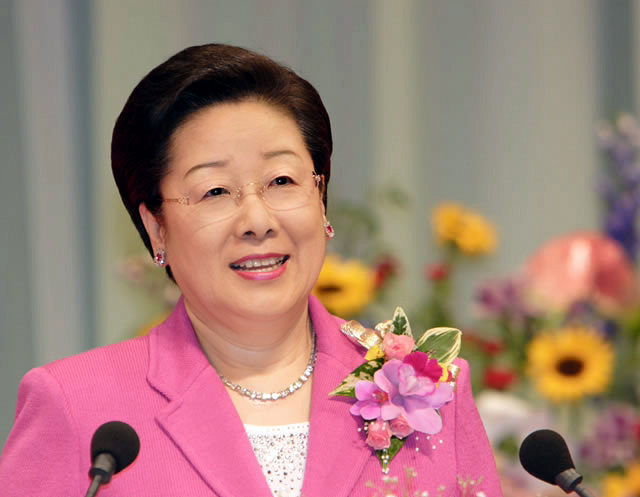
Challenges to True Mother’s Leadership

truemother

Part II of a two-part article. Part I can be read here.

By Thomas Selover

2014-04-23 15.01.09 croppedMany factors can be identified as contributing causes to the direct challenges that True Mother’s leadership has faced. Here I will focus on two elements of East Asian culture, the concept of filial piety and the Korean royal tradition.

The Problem of Filial Piety

One of the issues concerns the strength as well as the limitations of the traditional concept of filial piety (효孝). The centrality of filial piety in East Asian culture is widely recognized. Moreover, there are many passages in True Father’s teachings that emphasize the father-son relationship, particularly toward God as Heavenly Father.

A specific Confucian requirement of filial duty relevant to understanding the present controversies in the Unification movement is that a filial son should not make changes to his father’s ways for three years after the father has passed on. According to Confucius, “If for three years he makes no change from the ways of his father, he may be called filial.” Therefore, according to this tradition, it is a son’s duty not to make changes for at least three years. Thus, from a son’s point of view, objections to changes that were made during the three-year mourning period for True Father would have the backing of centuries of Confucian moral sensibility.

Filial piety is indeed a strong cultural virtue in East Asia, especially in Korea, and is good as far as it goes. But, in contrast, the classical Confucian tradition offers very little content on the husband-wife relationship. At best, the ontology of East Asian philosophy supports a concept of reciprocity between husband and wife, based on the yin-yang model, but reciprocity by itself can be emotionally cold. The Buddhist tradition also, with its emphasis on celibacy as a path of spiritual discipline, is lacking in persuasive accounts of relational love and virtue between husband and wife. The way that True Parents teach about the relationship between husband and wife, emphasizing true conjugal love as the core, is a missing ingredient in East Asian tradition.

Continue Reading→

The Providential Significance of True Mother’s Leadership

TrueMother1

This is Part I of a two-part article. Part II will appear next week.

By Thomas Selover

2014-04-23 15.01.09 croppedOn September 3, 2012, the Unification Church and movement entered a new and critical phase in its development. Long foretold by sociologists of religion and new religion watchers, the seonghwa (ascension) of Reverend Sun Myung Moon, the founder of the Unification movement, was accompanied and followed by anguish, confusion and realignment on various levels.

Even a brief review of the history of major religious movements shows that, in each case, the passing of the founder occasioned a fundamental transformation of the religious movement. Those movements that successfully transformed were able to survive and develop; those that did not have disappeared. The crisis of succession, or what sociologist Max Weber termed the problem of “the routinization of charisma,” would seem to be an inevitable turning point in the history of religious movements. The Unification movement is not an exception; this crisis and transformation were unavoidable.

The Unification movement is now in a very new stage of the providence, beyond what has been charted in previous understandings of the Principle and of Rev. Moon’s teachings. Even if events after his passing had unfolded in a different way, the novelty of the situation and its challenges would have been present nonetheless. Unification sources — especially the Divine Principle books, but also True Father’s speech volumes from earlier days — do not give us a comprehensive account of this time, although they do contain insights that we need. So there is a necessity for members to pray, study, and discuss together, seriously and respectfully.

Continue Reading→

Want To Be a Minister?

Silohuette of Preacher

By Tyler Hendricks

14_12_CfE_Tyler 10.55.08 pmThe path to professional ministry would seem to be simple, but it is very complex — for the aspirant and for the community they hope to serve.

In order to ordain their spiritual leaders, i.e., pastors, religious institutions have to: define their purposes, their beliefs, their standards of practice for members as well as leaders, put all this in writing, and set up methods to inculcate these things. Methods include general pastoral care and education as well as pastor preparation, measuring people’s performance in achieving them, and helping people overcome their failures in achieving them.

One indicator of the difficulties involved is that our Unification community, after over 60 years of formal existence and spreading throughout the world, has no ordination. What does one do to become a Unificationist pastor? What do pastors do? Do we even want pastors? Should pastors get paid? How do we assign a pastor to a congregation? By election or appointment? We have no formal or consistent answers to these questions.

Another indicator is the fact that it was not until now that we in the U.S. have set forth publically what it means to be a Unificationist, what is unique about us, what is our position on smoking and drinking, abortion, religious freedom, and many such matters (to get involved in this discussion, see the PDF “FAQ” on the FFWPU-USA site).

From the viewpoint of human history, this is not surprising. It takes religions a long time to decide these things. And there is a very compelling reason: in reality, for religions that last, the answers to these questions are not decided by theory, but by practice. We could call it “form follows function,” or use the traditional saying, “necessity is the mother of invention.”

What follows is a progress report on how this is working for our Unificationist community here in the U.S.

Continue Reading→

Justice, an Antiquated Notion

behindbars

By Alison Wakelin

Alison WakelinThe American justice system, “the best in the world” as we often hear on Sunday morning talk shows, has become a travesty of its former self. Even the most foundational of truths, the presumption of innocence until proven guilty, is under severe threat today. Like justice, it is becoming an antiquated notion.

Twenty-five percent of people in jail in this nation have not been convicted of any crime but are confined because they cannot come up with cash for bail. And for what are they waiting? Most of us assume they are awaiting trial, but it turns out only 3 percent of them will actually get a trial. 97% will plead guilty to something, even if they are totally innocent, rather than risk a longer sentence by appearing before a jury, on the advice of their defense attorney. This defense attorney may well have spent only five minutes reviewing the case before giving this advice, because it has nothing to do with the defendant. It has everything to do with the system.

In too many states, there is no requirement a prosecutor demonstrate criminal intent. Possibly for those who can afford an expensive defense attorney, this would be brought up as a defense, but generally, intent is irrelevant. Overwhelming numbers have now been criminalized by the system, as evidenced by the fact that with 5% of the world’s population America has 25% of the world’s prisoners. It seems highly unlikely that Americans are so much more inclined than the rest of the world to have criminal intentions, and so we must look elsewhere for an explanation.

The result of these overwhelming numbers has been a great increase in funding for prosecutors, with no corresponding increase for defense. It is a prosecutor’s dream. And to assure convictions, prosecutors simply have to add in a charge that carries with it a six-year mandatory minimum sentence. Few defendants are willing to risk this when they can plead guilty to a lesser charge that puts them in jail for a mere few months, or even lets them out with only probation.

Continue Reading→

Transcending Cain and Abel: Revolutionary and Reactionary Consciousness

cain-slaying-abel-jacopo-palma-1590

By Gordon L. Anderson

GordonIn the Divine Principle, the biblical story of Cain and Abel is seen as two brothers in a fallen family. Abel’s offering was accepted by God and Cain’s was not; Cain got angry and killed Abel and then fled his parents to start a new life. Abel is described as “closer to God,” but his consciousness is still that of an immature son and not a mature parent.

I often think of Cain and Abel as representing reactionary and revolutionary consciousness in the wider political spheres we see around us today. By “revolutionary” I mean the idea of “revolt” like Cain’s, and not peaceful revolution. These two different approaches to politics each claim to be right and when they compete with one another for political power, often end up repeating the “Fall” on a national scale.

Human society is always evolving as changes in science, technology and population lead to changes in human life. The reactionary refuses to adapt and looks for refuge in the past. The revolutionary recognizes the need for change but wants to violently jettison the past. The French Revolution and Communist Revolution in Russia are examples of “Cain-type” revolutions that led to violence and murder on a massive scale. By wiping out the traditional “reactionary” rulers, the Ancien Regime in France or the Czarist feudal system in Russia, and starting over, creating a new society, they ended up re-inventing many wheels and causing much evil, death and human suffering.

In developmental psychology, Cain and Abel attitudes represent typical responses of children who begin to compare and question at age 12 or 13. Children are born like sponges and soak up the environment of their parents and nurturers; they initially know no other way of life than the traditions they are given. However, as they begin to individuate, particularly in middle school, they begin to compare their lives to those of other schoolmates who came from different homes, with differences in wealth, discipline, religion, family integrity, etc.

Continue Reading→

The Best Policy Ideas of the 2016 Presidential Candidates

election-primary-vote-generic-default

By Gordon Anderson

GordonThe 2016 Presidential Election has raised a number of good policy ideas for the improvement of American society and government. Unfortunately, no single candidate endorses all of the best ideas, and, more unfortunately, every candidate who has good ideas seems to have more bad ones. Part of the reason is the development of a system that encourages candidates to be loyal to political parties and large campaign contributors rather than to middle-class citizens and the nation as a whole.

In my view, the best candidate would be one who supported all of these policies:

  • Bernie Sanders’ revival of the Glass-Stegall Act
  • Hillary Clinton’s call to overturn the Citizen’s United Supreme Court decision
  • Rand Paul’s foreign policy that is against U.S.-imposed regime change
  • Donald Trump’s middle-class tax policy
  • Carly Fiorina’s reforms of government bureaucracy

None of these policies are promoted by the establishment, which is why there is increased criticism of existing party platforms and why “outsiders” are polling so well with voters. Even most candidates that seek party endorsement are promising to reform the system.

The explanations for the value of my list of the best policies I describe below are adapted from a longer post on my blog, Life, Liberty, and the Pursuit of Happiness, Version 4.0, which includes further critique and commentary on the candidates and their policies. I have not discussed all candidates, only selected the most constructive policies being promoted.

Preparation to vote knowledgeably is an important role of the citizen in a democracy, and I encourage everyone to read through all the policy positions on candidates’ websites before their vote. A responsible voter will compare the strengths and weaknesses of a candidate in all areas of governance, and not just find agreement with a candidate’s rhetoric on a single issue.

Continue Reading→

The Responsibility of True Parents’ Successors

pass-the-torch

By Tyler Hendricks

14_12_CfE_Tyler 10.55.08 pmTrue Parents’ successors have the honor and responsibility to own and build Cheon Il Guk. As I studied some of True Father’s words on the subject, including statements going back to the early 1980s, three points emerged: One, that we all are successors; two, the notion of a central successor; and, three, the central successor’s qualifications and responsibilities.

First, God calls us all to be successors. True Parents come to lift us up into a relationship of parent-child with them. God and True Parents, like all parents, want their children to surpass them. Through the Holy Marriage Blessing, all blessed couples have the position of True Parents’ direct children.[1] The True Parents’ physical children, the True Children, and the blessed couples in general, are like Jacob and Esau, twins in True Mother’s womb, whether physically or sacramentally, in the “realm of the fourth Adam.”[2]  Thus, both True Children and all blessed families are entitled, by fulfilling certain responsibilities, to stand as owners of Cheon Il Guk, successors of True Parents.

I discern four such responsibilities that apply to all successors. Successors are to honor True Parents and True Children, who embody the ideal of God’s substantial Word, for it is through the reality of their oneness as a True Family of three generations that Satan’s accusations are overcome and all humankind may enter God’s direct dominion. On that foundation, all successors are to receive the Blessing, bless others, and work together to restore nations.

The Central Successor’s Responsibilities

Given Unification teachings regarding lineage, and human nature itself, most members have high expectations that the founders’ children will model God’s ideal. Father Moon supported this through statements such as, “The sons and daughters of Jesus’ direct lineage would have become the Popes.”[3] And Unification teachings lead us to expect the appointment of a central successor, as a couple, from among the 14 children.

Continue Reading→

The Sanctuary Church Schismatics

Front View of SC

By Michael Mickler

Mickler full-sizeThe Sanctuary Church (SC), with branches in the U.S. and overseas, is best understood as a schismatic movement. Followers of schismatic movements are known as schismatics. A schismatic is a person who creates or incites schism in an organization or who is a member of a splinter group.

SC, formally the “World Peace and Unification Sanctuary,” claims that the wider Unification movement has deviated from the teachings and practice of the Reverend Sun Myung Moon and that its purpose is to preserve and propagate his teaching.

The SC schism was several years in the making.

In 2013, SC Pastor Hyung Jin Moon, then International President of the Family Federation for World Peace and Unification (FFWPU, a.k.a. the Unification Church), refused the request of his mother, Hak Ja Han Moon, to take up duties under her in Korea. Instead, he relocated to the “wilderness” of Newfoundland, Pennsylvania, where he began an independent ministry. He was supported by his elder brother, Kook Jin Moon, who relocated Kahr Arms, which he heads, to nearby Pike County. Together, they purchased a church facility in 2014 and began the SC ministry.

Initially, SC uplifted gifts of grace and the Holy Spirit. Later, a “wilderness” mentality took hold and sermons turned apocalyptic. Hyung Jin Moon castigated “predatory elites” and “postmodern” thinking, gave credence to “truther” claims about the Twin Tower attacks, and emphasized prophetic speculation about Shmita year cycles and Blood Moon Tetrads. Then, in a series of sermons, beginning January 18, 2015, he broke decisively with FFWPU.

His epiphany was that the “predatory system of control… in the world at large” also was occurring in FFWPU. Based on this understanding, he directed Unification Church members to resign from FFWPU organizations. In a subsequent “Declaration of Heaven,” he announced the removal of all current leaders of the Unification Movement, declaring they had “no authority.” He called on members to take over church boards and elect replacements.

Continue Reading→

Website Built with WordPress.com.

Up ↑