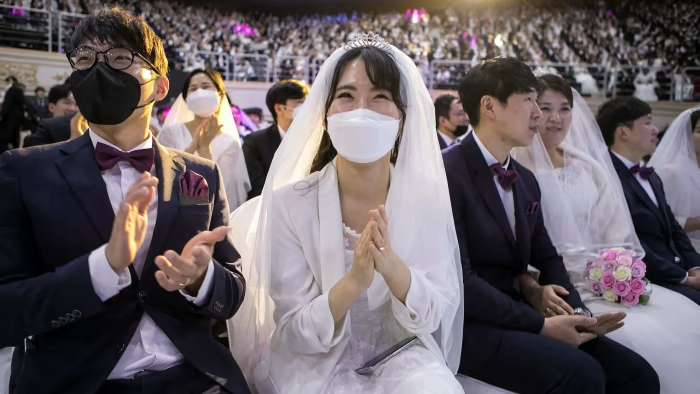

My daughter asked me recently, “Mom do you still think you were not part of a cult?” She had just finished watching a show about a dubious, if not dangerous, social media cult, and she caught me off guard. We’ve had these conversations before but now that she is in her thirties and I, recently turned 70, wisdom has hopefully given us a little perspective.
Cults hold an unending fascination with the American public since the infamous Jim Jones and the diabolical Charles Manson came on the scene during the searching 70s. When I joined the Unification church in 1973 the ‘cult’ word was not a part of the daily lexicon. The language I was drawn to in that flowered-power era were terms like kibbutz and commune, which in my youthful longings would include: sewing, farming, baking bread, and doing yoga (and eating yogurt which was only sold in ‘health nut’ stores as my mother called them).
As a teen living in a lazy American suburb where neighbors were strangers the idea of greater connectedness appealed to me. But so did a deeper understanding of Christianity. I was enamored with the rock opera Jesus Christ Superstar and C.S. Lewis and disillusioned with my Catholic upbringing, although I appreciate aspects of that now especially when the next world crisis nearly brings to my knees in prayer.
Today, cult-like groups offer people a sense of belonging in a world where despite our ability to connect like never before through social media, ironically, we feel more alienated than ever.
“Were you able to visit home?” she continued to query me. This question has been lobbed at me before as if it were a litmus test for being held captive in a cult.
“Yes, I was.” Our church was based in New York, and since I was from Delaware, I could pop home on occasion. Not sure I wanted to more than any other self-involved eighteen-year-old. But there was, in the church milieu, the unspoken: you’re all in, or you’re not. The Unified Family, as we called ourselves, circled the wagons against deprogrammers and focused exclusively on the ‘mission’ to save America. Although members were repeatedly instilled with the importance of family values, we often sacrificed those values in service to a higher purpose.
There existed an underlying tension, a twixt and between inside the church/outside the church. There were A members and B members. Home members weren’t really considered members by those in the mainstream movement. And children born outside the faith were in a separate category altogether. Ouch.
Through the Unification Church’s evolution and outreach work, primarily in the form of interdisciplinary conferences, this cognitive dissonance between inside the community and outside grew less jarring over time but never completely dissipated. Traces of identity crisis as a movement still reverberate from Korea to Las Vegas. It’s challenging for an international organization whose pride is in diversity to create one defining cultural experience where everyone—in or out—can feel welcomed.
What makes an organization cult-like?
Does the answer lie in belief or behavior?
What is a cult – as differentiated from a community of believers or just another church? And especially a dangerous cult that morphs into a mind-controlling, manipulative phenomenon where adherents are motivated to cast reason aside, drink Kool-aid-laced poison, and get branded to prove they belong? We can dig through the history a bit and find that ‘cults’ did not always carry a sinister connotation, although they’ve certainly well-earned this reputation in recent years.
The Cult of St. Olaf in the 1050s employs an early use of the word and refers to the king who brought Christianity to Norway. The word cult during that time was associated with the word identity—in this case, the spread of a Christian identity to the Scandinavian countries from England. If the word ‘cult’ had been used 2,000 years ago, surely Jesus’s followers would have been labeled as such. Furthermore, does one denomination, as opposed to another, define the true Christian identity? What is the true church?
A modern-day cult may not be limited to just factional religious sects–think of some of the political groups out there chanting sound-bite slogans or sports teams who paint their faces, or concertgoers whipping up a frenzy in a sound-deafening stadium. (I’m thinking of the one who famously sings about karma.) A friend refers to her innocuous public speaking group as cult-like due to its special language and its carrot-on-a-stick motivational tactics.
The internet definition of a cult is this: a small religious group that is not part of a larger and more accepted religion and that has beliefs regarded by many people as extreme or dangerous.
But cults and other groups—even your Aunt Tilly’s parties—can spawn a similar effect: the treatment of people as insiders and outsiders, which can translate as less preferential treatment toward those deemed as ‘others.’
Then my daughter shot me with the elephant in the room question: Do you still believe Rev. Moon is the Messiah? (This would fit under the category of cult of personality.)
I bumbled my response, saying my faith is about a teaching and not contingent on what one person says or does. “I joined—as many of us proclaimed back in the day–because of ‘the truth’; albeit a ‘truth’ that has been open to interpretation in ways we never envisioned at the start. What I could have told her was that if Sun Myung Moon and his wife, Hakja Han were not the embodied examples of the Divine Principle in action, then their teaching probably would not hold the same appeal. After all, there are lots of teachings, past and present, in circulation. The living reality of True Parents—their love, dedication, and sacrifices– to young members in the 1970s was infinitely more inspiring to emulate than dry diagrams on a dusty chalkboard.
When is a cult manipulative?
After forcing myself to watch several cult documentaries in order to understand better what makes them tick, it was obvious that a powerful leader was always at the helm. All things flow from the top. At first glance, a narcissistic leader can seem charismatic, but it will become apparent through their actions whether they are self-serving or membership-serving.
Coercion, arm twisting, sales tactics: If you pay this, you will achieve a higher level of consciousness; if you do this, you will gain this. Promises. Promises. Goals one can never reach hang tantalizing in a distance that keeps on disappearing, whether it means achieving self-realization or magical states such as being freed, cleared –insert any state of being here—that, in fact, cannot be bought, prayed for, or guaranteed.
Americans love shortcuts: express check-out lines, fast cars, and instant gratification, but they also value honesty, George Washington, who could not tell a lie, and Honest Abe Lincoln. Americans can pivot to a variety of viewpoints but they don’t like being deceived. So be upfront as to what you offer—and more importantly be unconditional. In these hard-to-trust times, people are understandably wary of hidden agendas.
When is a cult no longer a cult?
One theory is that when a cult’s practices are commonly known, and its achievements are well regarded by society, it no longer appears threatening. I’m not so sure. There are lots of accomplished, powerful organizations out there that still beg the question, are they a cult or not?
So where is that line? When is a dazzling ring in a jewelry store proven to be a two-bit cubic zirconia, and when does it sparkle? Is it a diamond in the rough? In these confusing times when the jewelry store has been ransacked and upended, how can anyone possibly discern the difference?
Mainstream impact can be proven over time. Naturally, if the Unification Church’s message is going to ignite the world and bring peace and unity on the Korean Peninsula–it’s hard to wait and watch the world go to hell in a torrent of climate change and war. It takes a billion years to create a diamond naturally. Feeling the urgency of the world’s situation, I find it hard to resist being pushy. Yet, that type of drive, if not softened by unconditional love, has sabotaged outreach efforts in the past.
The root words of cult and culture are similar
The words cult and culture share a Latin root, cultus, which has multiple meanings, including “tilling, cultivation,” “training or education,” and “adoration”. Both words can also refer to worship, and culture can also refer to a community’s aesthetic expression.
A belief system rooted in the ideal of the parental heart demonstrates unconditional giving without expecting a result. Rob Sayre, a founding member of Camp Shehaqua, once reminded me, “People do not want to join a cult; they want community.”
And here is a quote from Dr. Tyler Hendricks* who defines culture according to Unificationist ideals.
“A lineage naturally spawns a culture. The lineage Reverend Moon envisions combines all races, nations, and religions. Reverend Moon calls this universal culture of God’s lineage the “culture of heart.”
New York Times journalist David Brooks echoes the power of community in his new book, How to Know a Person: The Art of Seeing Others Deeply and Being Deeply Seen. According to Brooks, the answer to today’s polarization lies in hearing and validating one another. Listening—not preaching—is the hardest task of all.
Back to my conversation with my daughter. “I can see why you might have joined to have a sense of community,” she said. (But I didn’t!)
“So I’m glad you and Dad met in the Unification Church and had me and…”
“I know, think of it, you were born because of the Unification Church.”
“Yeah, and I guess I’m glad I was part of it in some way. It’s interesting.”
“Endlessly fascinating,” I replied.
So which is it? Cult, community, or another denomination?

It all comes down to the culture of heart
How often do we talk to someone we don’t know at church? Or do we gravitate towards those we’ve bonded with over the years? Do we repeatedly use insider language not only in our conversations with others but in our writings as well? Do we judge congregants based on status, category, or accomplishment?
“You belong to the ‘good cult’ she told me. “And I love you—no matter what.”
And whether it’s a cult, community, or culture of heart remains to be seen.⬥
Eileen Williams joined the Unification Church in Wilmington, Delaware in 1973. As a teenager, she remembers riding in the car with her mother by the local church center and wondering what that big word “Unification” meant. She’s still pondering. Eileen taught high school for several years including at the Bridgeport International Academy. She currently serves as a Guardian ad Litem in Vermont.


 Applied Unificationism
Interesting and well done piece, Eileen. The idea Eileen develops very well: I too am hard-pressed to name any religion that did not begin as a cult, by the current prevailing definitions.
Seems like you have an individual who, acting on a revelation, gathers a few followers. They start saying and doing things that threaten the established religions, part of whose mandate from heaven is to root out and destroy heresy, which is anything that goes against the prevailing teaching and the established order and lifestyle of the priest class. This is why new religions are always persecuted.
Will Unificationism, with cathedrals dotting the land, be just as intolerant to one of their fifth generation youth who walks in with an amending revelation? Likely, unless we maintain a living, active connection with God that keeps the door to revelations open.
Thank you for providing AU Blog readers with food for thought!
We can never be thankful enough… Incidentally, it can be a perfect way to avoid torturing our minds.
Some Catholics surprisingly came to think: “What a glorious fall that has given us such a Savior!” (O felix culpa quae talem et tantum meruit habere redemptorem).
Should children from communist couples who met and married within the communist party be grateful to Stalin or other leader?
Since we cannot change the past, we have to deal enthusiastically with our presently given opportunities, and make the best out of them.
Quite independent of my present and past beliefs, if Adam and Eve hadn’t eaten the forbidden fruit, I probably wouldn’t have the precious privilege to write this message, nor the grace to enjoy having my grandchildren playing and screaming around during our family gatherings…
You are not talking about the greatest coercive, arm-twisting, sales tactics program of all: the American advertising industry!
Larry, what is to prevent our church from spawning cult-like spin-offs, as has been happening to the Mormon (LDS) church of late? The connection to God, yes, and being ground in a teaching that still makes more sense to me than anything I’ve come across.
Jean-Jacques, I hope one day Heavenly Parent can sigh a big sigh of relief and say, “It was all worth it. It’s better than I even intended.”
We already have a couple of those. I think only a living presence of God within a church is its best defense against schism. I believe God can guide people. But as we know, not everyone is pure all the time. I can look into my own heart and see this.
Yes, Eileen, let’s ground ourselves and cherish what really does make sense for us, in order to keep in touch with both God’s and other people’s mind and heart. That’s indeed the prerequisite for meaningful heartfelt cooperation and the settlement of lasting peace on all levels.
Other highly hypothetical inconsistent legends, beliefs or revelations can’t really be helpful. On the contrary, they might end up deserving our original mind, in the long term. For they’ll probably sooner or later lead us to build the highest delusional ivory tower in the universe, while presumptuously estranging us from others, without realizing it.
In spite of it all, we are, each at our own pace, and definitely without following a straight line, increasingly heading towards the blissful heavenly realm we are meant to live in.
Perhaps neither a cult nor simply a community, but a new culture… of true heart. With both vertical (personal) and horizontal (communal) aspects.
Eileen,
Thanks for your sharing here. NIce. Beautiful.
There’s a song by The Association: “Enter the Young” (1966). It’s one of my favorite songs in the soft rock genre.
Here are the song lyrics:
Here they come
Here they come
Well, some are walking, some are riding
(Here they come, yeah)
And some are flying, some just gliding
Released after years of being kept in hiding
They’re climbing up the ladder, rung by rung
Enter the young (yeah)
Yeah, they’ve learned how to think
Enter the young (yeah)
More than you think, they think
Not only learned to think but to care
Not only learned to think but to dare
Enter the young
Yeah, here they come
Well, some with questions, some decisions
Here they come
And some with facts and some with visions
Of a place to multiply without the use of divisions
To win a prize that no one’s ever won
Enter the young (yeah)
Yeah, they’ve learned how to think
Enter the young (yeah)
More than you think, they think
Not only learned to think but to care
Not only learned to think but to dare
Enter the young
Enter the young
Here they come, yeah
Well, some are laughing, some are crying
Here they come
And some are doing, some are trying
Some are selling, some are buying
Some are living, some are dying
But demanding recognition one by one
Enter the young, yeah
Yeah, they’ve learned how to think
Enter the young, yeah
More than you think, they think
Not only learned to think but to care
Not only learned to think but to dare
Enter the young, yeah, enter the young, yeah
Enter the young, yeah, enter the young, yeah
Enter the young
The topic of whether or not Rev. Moon’s group is, or was ever, a cult is largely settled in our family.
Cult or Community?
Aren’t cults themselves also communities?
There are all kinds of communities; from the community of Taylor Swift fans, to the community of those who believe the earth is flat, to the sinister Wagner Group…
In the religious realm, the cult label is never self-awarded. Nobody goes around bragging to belong to a cult. A cult is always others’ reality. Cult members sadly don’t understand I detain the right beliefs!
People may bind together through common interest, common beliefs, or common fascination that led them to constitute specific communities. Some communities are very open, and transparency is their precious trump card. Other communities are more secret. They seem to have always something to hide and can be deceptive with outsiders.
The main question remains: Am I sectarian or not? Am I trustworthy or not?
I guess it all depends on the size of my genuinely loving embrace. Do I honestly strive to live according to the Golden Rule?
Marcus Aurelius advised us:
“Be careful never to have the same feelings towards misanthropes as misanthropes have towards men.”
I’ve known Eileen since 1976, and since she quoted me here, I’ll take the time to respond.
We drove together from Wyoming to NYC for the Yankee Stadium campaign. My experience after joining our movement in 1973 was unusual in some ways, and in others not. I thought we were going to create small communities of faith and usher in a New Age. I witnessed to my brother and his wife (with two small kids at the time), my parents, grandparents and one of my best friends from high school. They all joined, for a time. My parents and grqndparents were “associate members.” They loved the members at 777 Broadway in Boulder, Colorado (my hometown), but as leaders and members came and went, they were just kind of forgotten. They were practical, former ranch people of the West, well known in our town. They met our members, listened and made up their minds for themselves. Their religion was service to others, so doctrine or rituals did not interfere with their understanding.
My brother and his family soon found out there was really no place for them and simply moved on with making a living and raising their two children. My best friend, a kind soul that he was was not cut out for the army like in the early 70’s. The day he took a bus back home, we talked, I told him I loved him and would always be his friend. He died in a rock climbing accident in Colorado a few years later. I think of him often. I have attended my high school reunions with my wife for many years, so they have met her (dang dude, how did you hook up with her!?). She has made friends with some and heard stories about me that only those you grew up know! I was not a Catholic from the Midwest!
When I met Rev. Vincenz in Seattle in 1974, I realized we were not going to create communities of faith, as I had envisioned, but were more on a war-campaign footing, with a perpetual, “there is only three more years” for this or that to be completed. Was I in a cult? They did not think so. My parents sent donations to wherever I was. When they met my then fiance, Sally West, they were estatic. A midwest girl, Catholic from Indiana. My mother came to our blessing in 1982 at MSG. My grandfather was able to meet our two daughters as infants before he passed in 1985 at age 95. I felt perhaps like my brother did when he was a Marine in Vietnam. I picked up 4-5 other spiritual children along the way, some are still around.
In 1995, after moving to Pennsylvania to take a job at a publishing company, Rodale, Inc., we wanted to create an experience for our two girls. We organized our own programs with a few other families and 30 years later, our programs was still going, now lead by Second Generation. There is a lot to say on that, my wife is writing a book on that. Our three core goals were (1) to provide age appropriate DP, (2) to provide personal experiences with God (3); and, to allow kids and their families to experience a community of faith. You know what turned out to be most important and lasting? Hands down, the bonds and friendships and the community of faith they experienced. Trust me, many know each other.
We saw perhaps 1,000 kids go through the programs at Shehaqua. Some are blessed and active, most not, but they are amazing people doing great things with their lives. Were they in a cult? We were employed and lived outside the core areas where the movement was since 1988, so I am not sure if I am the best person to answer that question. Our girls are doing great and we still hear from “those kids” now in their late 20’s, 30’s and even 40! I wrote on Shehaqua on this blog. It is entitled “Converting Good Intentions Into Results.”
I will say, in closing, my experience is a community of faith, even an imperfect one is more important than any theology or new revelation. Rituals are important for some. Others may have different experiences or points of view.
“You know what turned out to be most important and lasting? Hands down, the bonds and friendships and the community of faith they experienced.” Yup.
Rob, et al.,
When you write that what was most enduring for the success of what we used to call Family Camp was “to allow kids and their families to experience a community of faith,” I agree wholeheartedly except for the last word. I think what we experienced was a community of love, love in action, agape embodied, not merely faith therein. And love forgives imperfection, does not require conformity for conformity’s sake, judges not (which is not to say there weren’t clear boundaries for behavior so that people could feel safe and at ease) and we did indeed “live for joy” without it being cult-like, but instead folksy.
Among adults was an intrinsic sense of respect toward one another as adults, not as “members”. Too often the theological notion of “love others as children of God” means infantilizing the other, presupposing that one is armed with the “superior” theology and therefore in the “parental” (read subjective) position toward the other who is rhetorically and interpersonally placed in the position of “object” or child per DP.
Of course, subject and object are in constant flux and dynamic. However, the chauvinistic imposition of theology over heart imposes rather than invites, dominates and judges rather than serving while remaining curious. Curiosity, taking a sincere interest in the other without fear, as one does in a conversation between friends, is different from “having give and take” to serve “a higher purpose” in the militaristic sense of the movement (as in “we are God’s chosen people and know better than everybody else what God’s will is”).
Ultimately, it was about having clear boundaries for behavior but without imposing boundaries upon faith. Family Camp, as Rob & Sally, et al. set it up, granted the beautiful God-given right of free will to others to *think* the way they wanted to. It did not impose censorship upon the mind or judge the heart finding its way with the divine or others. It kept everyone safe, yet allowed the kooky, comedic or even reckless abandon of the heart to find its own unique rapport with the divine and one another. It felt naturally wholesome.
I think this is part of the difference between “cult” and “religion” as Eileen so thoughtfully explores. If religion offers the opportunity to “re-bind” with God, it does so without requiring one believe a particular way. That’s the free will portion. The Inquisition, for example, required a certain way of believing and behaving and threatened draconian consequences for those judged to have violated these strictures.
That sort of thing was absent from Family Camp. Having clearly defined boundaries allowed for the free flow of ideas and interactions the way having a median and agreed upon signage on the highway keeps traffic moving. And as some anthropologist wrote, alternate merge (a free-will choice) is the ultimate indication of civilization. Family Camp offered ample good will for alternate merging and then some.
Thank you, Eileen, for raising these issues with grace, and good to hear from Rob. I have never been to Camp Shehaqua but have heard a lot about it. In Montreal, we have Camp Boreal which is still doing well.
But as one who was kidnapped by his family in ’81 and who spent a week with deprogrammers, the word cult takes on a different meaning. These people tried to make me believe that I got involved with a destructive bunch but I could tell easily that they didn’t really believe in their theory. I was able to escape and they just ran away with the money that they squeezed from my parents.
Deprogramming in America ended in the 90’s with successful court battles. Unfortunately, in Japan it affected the spiritual lives of over 4,300 members and our movement there is still fighting for its religious freedom.
But 44 years or so after my encounter with deprogramming, I am preparing to go to Korea to attend the entrance ceremony of our world level sanctuary. The Cheon Pyong Lake providence has been going on for 30 years and may appear strange to some as it deals with the spiritual realm.
Actually, we don’t know what is going on on the other side of life. But we do know that people are highly influenced by it in good and evil ways. The purification of the spiritual world that has come with the liberation and blessing of ancestors is significant.
Therefore, are we are a cult or a community? I think that we are an international movement and a worldwide community. We can go anywhere in the world and meet brothers and sisters as our own relatives. Our movement has touched every aspect of society.
True Mother considers the 8 billion people of the world as her own children. In her last world tour which culminated at the 2020 World Summit, she embraced all continents at the risk of her life and made breakthroughs in Africa and the Muslim world. We are all her children as she keeps repeating to us.
Sometime though, the ones most difficult to reach are our own children. While they are doing great things with their lives, we may just need to apply with them the treatment that True Parents gave to us: the one of unconditional love.
Are we (now) a cult? Depends on how you define “we” and cult”!
Once a cult becomes mainstream, it ceases to be regarded as despicable, but appears as a glorious community.
Would Paula White be offended if someone told her she belongs to “the sect of the Nazarene”? Not at all. She would feel honored!
Outsiders and historians of religions might have had a wrong perception and an unkind labelling while observing the laborious and rather hectic development of God’s providence.
Who knows? What some people will have previously labelled as “Moon sect,” or “Moon-idolatry” and then “Han-idolatry,” might in the future not offend fervent Unificationists any longer, but instead become an honor for them.
However, alongside the song from Felix Leclerc, “Quand les hommes vivront d’amour” (“When men will live by love”), we won’t be around any longer, my brother (and sister), on that beautiful day.
But neither will we be too far.
And without nostalgia, we’ll definitely keep the happy feeling we somehow did our share and greatly learned a lot from that.