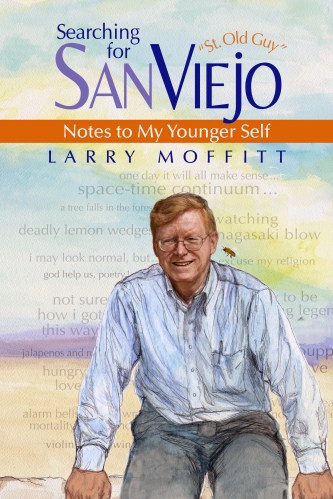
Excuse My Religion While It Slips into Something More Comfortable

By Larry Moffitt

I was speaking with the minister of a very large Christian church in Houston. We were in his office discussing the enigmatic lightning rod personality that is Reverend Moon, who was still living and quite active. He asked me by whose authority was Reverend Moon ordained a minister? A legitimate question. I replied, “Jesus spoke to him on Easter morning in 1935 when he was fifteen, and gave him his mission. So I guess that was his ordination.”

The minister’s back stiffened. He glared, making fists in his pockets. “Jesus did not speak to Reverend Moon!”

“I see,” I said. “I have to wonder how you could possibly know that.” I spoke evenly and without a hint of disrespect. If it’s audacious for me to believe that Jesus actually spoke to him, isn’t it also audacious for someone living on this side of the veil to be confident about what Jesus does to fill his time on the other side? Does he putter in the garden? Write music? Continue to guide people’s spiritual lives? I should have followed up with these questions because at least he knew what Jesus does not do: He does not speak to people.

“Well, God also spoke to him,” I added helpfully.

Surely this would clinch it because God has gone on the public record many times. I mentioned as examples, Noah, Moses and John the Baptist, in whose honor this minister’s church was named. It’s well-documented phenomena, so surely it would be easy for him to accept that God can speak to people if he wants to. But alas…

“God doesn’t do that anymore,” he said, slamming the door on the conversation.
Continue Reading—>

Mega-Cities and the Globalization of Religions

By Ronald Brown

At the dawn of the 21st century, the mega-city is rapidly becoming the stage for the transition of local religions to the status of global religions. Once relegated to the margins of world religions, migration to the world mega-cities has catapulted them to the status of world religions.

This article analyzes the five stages in the globalization of religions and applies them to the Unification Movement in the context of developments in Caribbean culture. The stages are: religions in the mega-city; the role of the media globalizing religions; the establishment of a formal clergy; the institutionalization of religions; and, religions and academia.

Religions in the mega-cities

United Nations statistics show that over half of the world’s population resided in cities over one million in population as of 2007 and urbanites are predicted to comprise 70% of the world’s population by 2050. These statistics include rural residents fleeing poverty to cities in their own country as well as mega-cities in other countries.

Among these new urbanites are some 60 million settlers from the Caribbean islands. This demographic reality has a double effect on the migrants. Firstly, Caribbean people are being transformed from residents of isolated islands into global urbanites. The majority are uneducated poor rural farmers fleeing poverty, landlord oppression, and semi-slave factory work. They establish urban ghettos in their new mega-city home and seek to recreate a semblance of their island homelands.

Secondly, in this often hostile mega-city environment, the migrants cling to the religions, cultures, and traditions of their island homelands. Isolated, fearful, and often persecuted, they construct ethnic neighborhoods. Often the citizens of their new homelands are intrigued by these exotic newcomers, visit their neighborhoods, and attend their religious observances. Suddenly, a local island cult is a global reality.

The Unification Movement was founded by the Reverend Sun Myung Moon in Seoul, South Korea, in 1954.

Continue Reading—>

Oscar-Winning Films that Address Racism

By Kathy Winings

Three very different films released in 2018 address racism from unique perspectives. Two are based on real events and the third is an adaptation of a James Baldwin novel. Each film also won at least one Oscar at February’s Academy Awards.

Set in the early 1970s, “If Beale Street Could Talk” is a quintessential Baldwin story about poverty, race, family, and love. The film is directed by Barry Jenkins, director of the 2017 Best Picture Oscar winner, “Moonlight.” Regina King received the Oscar for Best Supporting Actress for her strong portrayal of the mother of the story’s young heroine, Tish.

Tish (KiKi Layne) and Fonny (Stephen James) are a young black couple living in Harlem who fall in love and find themselves expecting their first baby. But Baldwin’s complex story doesn’t end there. At a time when a young couple awaiting their first child should be excited and anxiously preparing for the birth, the realities of one’s identity mars that anticipation.

As fate would have it, Fonny is wrongly arrested for the alleged rape of a young Puerto Rican woman. A white policeman known for his racist attitudes makes the arrest. While Fonny is lingering in jail awaiting trial, Tish, her mother and sister try to fight for Fonny’s freedom but it is an uphill battle. For one, the Puerto Rican woman who was brutally raped is not to be found. Second, the one witness, a young African American who can verify that Fonny was nowhere near where the scene of the rape, is also arrested on questionable charges. As a result, Fonny remains in prison while hoping for a quick resolution of his case — a fairly standard experience for black men in Harlem of that time.

Baldwin was gifted in portraying the challenges of the American working class black family struggling to survive, economically and emotionally, recognizing how tenuous life could be when you were black and fighting a system bent on ensuring you did not succeed. It is clear that fighting racism and racist attitudes is an uphill battle for Tish and Fonny. Young black men knew if they were arrested for crimes they did not commit, they could linger in prison for years with some even dying there at worst or learning destructive lifestyles at best. The longer Fonny is incarcerated, the more he begins to accept the inevitable. Tish, though, is relentless.

Continue Reading—>

Insights from the Bible for a Scripture of True Parents

By Andrew Wilson

I recently returned from a conference in Korea that asked, “What should be in a scripture that testifies to Rev. Sun Myung Moon and Dr. Hak Ja Han Moon as True Parents?”

In considering this question as a biblical scholar, there is no better starting point than to examine the Bible and its testimony to Jesus Christ. The elements of that testimony made the Bible an effective witness, which spread the faith of Jesus to the more than two billion Christians throughout the world.

There are many elements to that testimony which make it effective. For example, the Gospels make effective use of narrative, present Jesus’ words as short, pithy sayings, and convey his teachings through parables and incidents that are short and easily impress themselves on the mind. Words of Jesus are interspersed with his actions, creating a dramatic narrative.

There are also conversations between Jesus and his disciples that convey his teachings. Finally, there are theological assertions about who Jesus is. Through these literary devices, the four Gospels in little over 100 pages convey a clear impression of Jesus and his work.

I would like to see a scripture of this sort written. I envision it would not be an extensive anthology like Chambumo Gyeongour current scripture of True Parents. To keep it concise, it would have to be selective rather than comprehensive. Designed to move the heart, it would be short enough to be easily digested by all people of the world.

However, I leave aside this issue of style and form, although it deserves attention in its own right. Rather, I explore certain issues of content, focusing on three points: 1) The historical context of the advent of Jesus and its significance for True Parents; 2) the lack of historical context for the advent of True Mother; and, 3) the issue of endings.

The Historical Context of the Advent of Jesus and Its Significance for True Parents

The Bible includes as historical background the providence in the Old Testament that culminates in the Jewish messianic expectations and prophecies about the Messiah. These it weaves into its accounts of Jesus.

Continue Reading—>

The Concept of Truth and the Interpretation of Scripture

By Gordon Anderson

In most seminaries and academic institutions, since the rise of critical methods of scholarship, scripture has been studied by applying methods of literary and historical criticism.

Literary criticism views scripture as human writing that conveys moral lessons, values and truths rather than the direct writing of God. Yet, it does not deny the existence of God or imply that the writing is not important to read for attaining a better personal life, a better world or closeness to God.

Historical criticism investigates the historical world around the origin of the ancient texts to better understand the worldviews that shaped the writing and aids dating of writings and events.

Here, I propose the concept of “truth criticism” as a further tool of scriptural analysis.

Theories of Truth and the Interpretation of Scripture

One part of the truth criticism I propose is based on an integral view of truth. On this site last year, Dr. Keisuke Noda described four theories of truth that have evolved since ancient times. These are: the correspondence theory of truth, coherence theory of truth, pragmatic theory of truth, and existential theory of truth. Since each of these approaches describes ways in which something can be viewed to be true, the integral theory of truth Dr. Noda proposes enables us to see in which ways something being studied is “true” and which ways it is not.

For example, historical criticism tells us that the Ten Commandments are very similar to core elements of the Hammurabi Code found on a stone stele in Persia, now on display in the Louvre. This seems to disconfirm the “correspondence theory of truth,” or literal interpretation of the Bible, that these commandments were introduced by a supernatural event in which they miraculously appeared on tablets in Mount Sinai. Those commandments were part of a larger body of knowledge that Moses could have inherited and believed to be essential conduct for a godly society.

The idea that the commandments were emblazoned by fire from a supernatural being could well be a literary device.

Continue Reading—>

Reclaiming January 1 for a Heavenly USA?

By Alan Jessen

This year, on January 1, True Mother, Mrs. Hak Ja Han Moon, had a midnight prayer and gave a motto, an event which was live-streamed. This may be an indication of her reinstituting in some way the observance of the New Year by the solar calendar.

Why is this important?

Consider Romania.  For 45 years under communist rule, Christmas was forbidden to be celebrated as a public holiday.  By law, there was no mention of Christmas, no days off for Christmas, no “Merry Christmas,” or even Santa Claus.  The Romanian communists tried to detract from Christmas by making grandiose plans for January 1 as a public holiday.  Communist doctrine was taught in schools from kindergarten through college.  Religion was considered the opium of the masses.

Despite this, they could not remove Christmas from the hearts of the people and on December 25, 1989, when dictator Nicolae Ceausescu was no more, the Romanians broke out in joyful cries of “Cracium Fericit” or “Merry Christmas,” and shouted out at the top of their lungs.

When I finished reading about this, I asked myself, what public holiday, what tradition do we Unificationists in America have that could sustain us under such conditions for two generations?

Think about what easily recognizable annual event we have as a tradition that can serve to unite us as one family at one time across America; that affords parents an opportunity to reinforce our values of putting God in the center of our lives; and, that serves best to create lasting spiritual impressions for our young ones?

During the years True Parents lived in America, that day was God’s Day — celebrated on January 1st.

We recently finished our 2019 Holy Week in Korea — a combination of Heavenly Parents Day, True Parents Birthday and the sixth Foundation Day.  Although I never attended these events in person, I can observe that True Mother has done a fabulous job of creating a world class hyo-jeong culture experience.  It is overflowing with dance, music, high-spirited celebrations, meetings of our global leadership, and opportunities to recognize and involve world-level leaders on issues of global peace.

Continue Reading—>

Aquarian Angst: Woodstock at 50

By David Eaton

This year marks the 50th anniversary of the Woodstock music festival.

Flashing back to that “summer of love,” I’m reminded of two iconic before-and-after photos: one depicting a sea of humanity reveling in the music of their idols on Max Yasgur’s farm in upstate New York, the other revealing the horrible mess of mud and refuse left behind.

Juxtaposed, these two images are emblematic of a generation that grew up on rock and roll, loved to get high, party hard, and indulge in “free love,” often with reckless abandon. Living the Bohemian lifestyle of carefree license, unfettered by “traditional values,” became the fantasy of an entire generation — and music was at the vortex of that counterculture revolution.

The Woodstock generation waxed poetic about peace, love and universal brotherhood, and music was deemed a leading force ushering in a utopian era in which greed, selfishness and all manner of “plastic” values would be expunged. John Lennon and Yoko Ono implored us to “give peace a chance.” The hopes and dreams of an Aquarian Age, a time when “love would steer the stars,” and “we’ll study war no more” would become a reality — or so we thought.

Our love of music became a quasi-religion. “Make love, not war” was our credo, sex and drugs our sacraments, and rock ‘n roll was the music that accompanied the liturgy. In spite of our New Age optimism about making the planet a better place for our children and “getting back to the garden,” the spirit of rebellion and defiance was pervasive, and the music of the era reflected that rebelliousness.

In retrospect, Woodstock may have been more of a moment rather than a movement. As that “after” photo might suggest, the Woodstock generation has been rather messy in the ensuing decades with regard to love, life and its pursuit of happiness.

Continue Reading—>

Deep History

By Ronald Brown

“Deep history” is the deeply-rooted impulse that drives a nation, shapes the identities of peoples, and determines its present activities and future goals.

For many nations, some mythical past shaped this impulse while for new nations it is still being created. Here, I apply “deep history” to mean those primal characteristics of a people that defy the tumult of the centuries, remain immutable to individual leadership, and determine the destiny of a people.

This theory slowly evolved during my five years of university study in Jerusalem (1971-76), many visits thereafter, and most recently, my trip to the Holy Land last August.

Examples of deep history

The challenges of nationalism, socialism, communism, and Western-style separation of church and state have done little to undermine the fundamental and deeply-rooted Muslim belief that the goal of the religion is to create an Islamic state. The current global crusade to defeat so-called “Islamist ideology” is fated to failure. Muslim dedication to an Islamic state is as deeply-rooted in the faith and resistant to the vicissitudes of history as the resurrection of Jesus is in Christianity.

Western colonial expansion into North Africa, the Middle East, and Southeast Asia, the 1924 abolition of the caliphate, and 1948 Jewish occupation of Palestine resulted in a rebirth of Islamic deep history. The Muslim Brotherhood, ISIS and al-Qaida rejected Western nationalism, socialism, communism, secularism, and separation of church and state to reunite the shattered body of the Islamic umma and restore the caliphate.

China likewise is permeated with the idea that the Confucian social, economic and political order is universally applicable, and that its destiny is to spread this model worldwide. Even during the “Century of Humiliation,” when it was at the mercy of Western imperial powers, China remained firm in the belief of its divine destiny.

Political scientist Francis Fukuyama greeted the fall of Soviet Marxism in his 1992 book, The End of History and the Last Man. The Soviet Empire would finally join the rest of the planet in embracing parliamentary democracy, capitalism, and the rule of law. But by 2000, Russian deep history reared its head from the rubble of the collapsed Soviet Empire and Vladimir Putin resumed Russia’s imperial march as the Third Rome.

Continue Reading—>

“Welcome to Marwen”: The Remaking of a Life

By Kathy Winings

In April 2000, just across the Hudson River from UTS’s Barrytown campus, a terrible assault took place outside a bar in Kingston, New York, an historic city that served as New York’s first capital.

Mark Hogancamp, an artist and showroom designer, was beaten almost to death by five young men using just their fists and feet. While drinking, Hogancamp had let slip that in the privacy of his own home, he was a cross-dresser. Taking exception to that, the thugs waited outside the bar and attacked him.

Suffering extensive brain damage, Hogancamp spent over 40 days in the hospital, including nine in a coma, healing and relearning how to walk, talk, eat, and trying to live a normal life.

Fortunately for him, Hogancamp awoke with no memory of the attack — but he also lost memory of his past life. It meant he had to find a way to deal with his constant anger and depression — all of which resulted from his traumatic brain injury. Thus was born the tiny village of Marwencol.

Built out of plywood scraps and other materials he found lying around, Hogancamp created an imaginary Belgian village and populated it with Barbie dolls and World War II action figures. Daily life was built around World War II narratives that he created, featuring the women as a band of heroes led by one American solider — Captain Hogie — going head to head with five Nazi soldiers in these different scenarios.

Marwencol became Hogancamp’s therapy on a daily basis. It also became a way for him to find a new career. As he played out his stories through posing the dolls in Marwencol, Hogancamp began to photograph them, ultimately coming to the public’s attention and establishing his career through gallery exhibitions that showcased his unique photographs.

This is the background story for director Robert Zemeckis’ new film, “Welcome to Marwen,” starring Steve Carell as Hogancamp and Leslie Mann as his neighbor, Nicol, who becomes his good friend as well as the inspiration for one of his female soldiers in Marwencol.

Continue Reading—>

Website Built with WordPress.com.

Up ↑