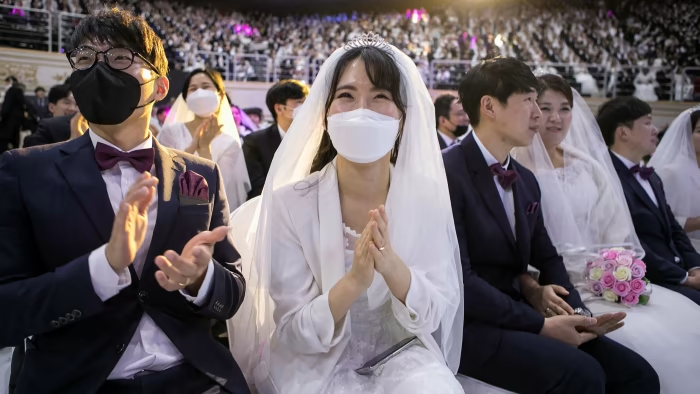

My daughter asked me recently, “Mom do you still think you were not part of a cult?” She had just finished watching a show about a dubious, if not dangerous, social media cult, and she caught me off guard. We’ve had these conversations before but now that she is in her thirties and I, recently turned 70, wisdom has hopefully given us a little perspective.
Cults hold an unending fascination with the American public since the infamous Jim Jones and the diabolical Charles Manson came on the scene during the searching 70s. When I joined the Unification church in 1973 the ‘cult’ word was not a part of the daily lexicon. The language I was drawn to in that flowered-power era were terms like kibbutz and commune, which in my youthful longings would include: sewing, farming, baking bread, and doing yoga (and eating yogurt which was only sold in ‘health nut’ stores as my mother called them).
As a teen living in a lazy American suburb where neighbors were strangers the idea of greater connectedness appealed to me. But so did a deeper understanding of Christianity. I was enamored with the rock opera Jesus Christ Superstar and C.S. Lewis and disillusioned with my Catholic upbringing, although I appreciate aspects of that now especially when the next world crisis nearly brings to my knees in prayer.
Today, cult-like groups offer people a sense of belonging in a world where despite our ability to connect like never before through social media, ironically, we feel more alienated than ever.
“Were you able to visit home?” she continued to query me. This question has been lobbed at me before as if it were a litmus test for being held captive in a cult.
“Yes, I was.” Our church was based in New York, and since I was from Delaware, I could pop home on occasion. Not sure I wanted to more than any other self-involved eighteen-year-old. But there was, in the church milieu, the unspoken: you’re all in, or you’re not. The Unified Family, as we called ourselves, circled the wagons against deprogrammers and focused exclusively on the ‘mission’ to save America. Although members were repeatedly instilled with the importance of family values, we often sacrificed those values in service to a higher purpose.
There existed an underlying tension, a twixt and between inside the church/outside the church. There were A members and B members. Home members weren’t really considered members by those in the mainstream movement. And children born outside the faith were in a separate category altogether. Ouch.
Through the Unification Church’s evolution and outreach work, primarily in the form of interdisciplinary conferences, this cognitive dissonance between inside the community and outside grew less jarring over time but never completely dissipated. Traces of identity crisis as a movement still reverberate from Korea to Las Vegas. It’s challenging for an international organization whose pride is in diversity to create one defining cultural experience where everyone—in or out—can feel welcomed.

 Applied Unificationism
Recent Comments