
By Michael Mickler, Professor of Church History, UTS
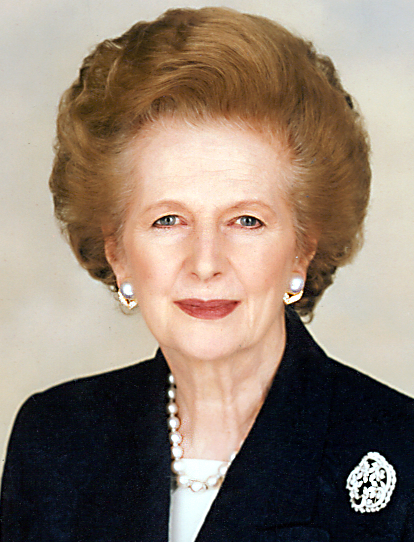
 Former British prime minister Margaret Thatcher (1925-2013) was a friend of the Unification movement. In 2007, on the 25th anniversary of The Washington Times, she sent a warm video tribute. The following year she accepted the Universal Peace Federation’s Leadership and Good Governance Award, and in 2010, on the occasion of Rev. Moon’s 90th birthday, she sent a hand-written greeting expressing her hope that it would be a “splendid occasion.” Her appreciation stemmed from a common interest in combating global communism and promoting the values of “family, faith, and freedom.” She likely was unaware of Rev. Moon’s pronouncements regarding an emerging era of women. Nonetheless, her career as a national and world leader provides a model that resonates with Unification values.
Thatcher’s passing on April 8 evoked wildly divisive estimations of her contributions to British and world society, including the advancement of women. In “Margaret Thatcher was No Feminist,” Hadley Freeman wrote in the Guardian, “Far from ‘smashing the glass ceiling’, she was the aberration, the one who got through and then pulled the ladder up right after her.” She described Thatcher as “one of the clearest examples of the fact that a successful woman doesn’t always mean a step forward for women,” noting that in her lengthy term as prime minister, she promoted only one female to her cabinet. Others disagreed. Lionel Shriver, writing for Slate, termed Thatcher “a real feminist. Not for what she said but for what she did … If we had more feminists like Thatcher, we’d have vastly more women in Parliament and the U.S. Senate.” Bruce Thornton, a fellow at Stanford’s Hoover Institution, agreed. “In any morally coherent and intellectually honest world,” he argued, “Thatcher would be a major feminist hero.”
Thatcher expressed several of her core convictions in a 1982 speech on “Women in a Changing World.” In the speech, she expressed disappointment that “more than half a century after all women got the vote, there are only twenty-one women Members of Parliament out of a house of 635 Members.” She said it is “just” that women have full participation in politics and important that public life “be shaped and influenced by the special talents and experiences of women.” So far, so good. The rub came when Thatcher claimed these “special talents and experiences” derived from home life, specifically bearing children and running a household. Many of the early suffragettes, she contended, were “very womanly,” with a “background of full and happy domestic lives.” They were “warm as well as immensely capable” and brought “enriched lives” to public service. In particular, the “many practical skills and management qualities needed to make a home” gave women “an ability to deal with a variety of problems and to do so quickly.” It was this “versatility and decisiveness” that she regarded as being “so valuable in public life.”
Her sentiments, of course, were tinged with more than a little traditional, even Victorian, values and biases. However, there was an important difference. Victorian traditionalists conceded women’s gifts in the domestic sphere but failed to see that they were temperamentally suited or had much of a role outside of its bounds, especially in the rough-and-tumble world of politics. This was a position Thatcher emphatically rejected, arguing as she did that household management afforded a distinctive skill set for public service. As she put it, “the home should be the centre but not the boundary of a woman’s life.” In this respect, Thatcher identified with what is commonly termed “first wave” or “equity” feminism which focused on legal inequalities, most notably obtaining the vote. According to her, “the battle for women’s rights has been largely won.”
As a consequence, Thatcher drew a hard line between first and second wave feminism, often referred to as “women’s liberation,” which emerged during the early 1960s. She said, “I owe nothing to women’s lib” and described it as “fashionable rot” and “poison.” She associated it with lessened regard for the family and an exaggerated emphasis on “individual rights.” She also insisted that women be promoted on the basis of merit, not sisterhood. She did not utilize the terminology of sexism but clearly considered second wave feminism to be sexist. If it was wrong to be held back by gender, it was equally wrong to be privileged by gender. Thatcher never claimed that women possessed innate capacities that entitled them to leadership. She did argue that women brought “special talents” to public service. However, these were not inborn but developed through life experience, particularly raising children and maintaining a household. She did not consider either of these roles to be sexist or oppressive but referred to “the inestimable privilege of being wives and mothers.”
Thatcher was not alone in criticizing second wave feminism. Bruce Thornton defined it as “a species of progressive identity politics predicated on perpetual victimhood as a means for extorting more social and political clout.”According to him, it has been “dead for decades” but continues “a zombie-like existence, stumbling around the universities, popular culture, and the media.” In fact, a third wave dislodged second wave feminism during the 1990s. Post-modernist third wavers embraced diversity and challenged the second wave’s assumption of a “universal female identity.” Most of them regarded gender as an artificial construct. They rejected the male/female binary opposition and introduced elements of queer theory, womanism, cyberfeminism, ecofeminism, and transgender politics in upholding a fluid notion of gender.
Thatcher was far from being a third wave feminist. However, her philosophy and career resonated with aspects of all three feminist waves. She clearly identified with first wave feminism and likely saw her career as its fulfillment. As the first woman to become prime minister of Britain and the first to lead a major Western power in modern times, she held office for eleven years (1979-90), longer than any British politician in the twentieth century. More striking was the ease with which she exercised power. An ABC News correspondent tweeted, “Many of us grew up watching Margaret Thatcher on TV, thinking it was perfectly normal for a woman to lead a great power. It wasn’t.”
Thatcher hated the “strident tone” and politics of second wave feminism. Nevertheless, she resonated, at least partially, with its male/female binary opposition. Her personal style, as one commentator noted, was “unapologetically feminine.” Her bouffant hairdo, tailored skirt suits, and “ubiquitous handbag” were “internationally iconic.” She reportedly told a confidante that being elected to the International Best Dressed List in 1988 as a model of “of classic middle-of-the-road elegance” was “one of the greatest moments of my life.” Apart from style, she occasionally drew managerial distinctions between women and men. On one occasion, she said, “I’ve got a woman’s ability to stick to a job and get on with it when everyone else walks off and leaves it.” Another time, she stated, “the cock may crow but it’s the hen who lays the eggs.”
Thatcher could not have been further away from third wave feminists’ uninhibited deconstruction of traditional monogamy. However, as Lionel Shriver notes, she “consistently defied gender stereotypes.” These included views as to a woman’s prerogative to change her mind, about being sentimental and soft, and about preferences for compromise, harmony, consensus-building and accommodation. In contrast to these stereotypical views, Thatcher was “rarely willing to concede a point and loath to compromise.” In the face of early challenges, she famously announced, “The lady’s not for turning.” The Soviets nicknamed her the “Iron Lady,” and she demonstrated steely, unsentimental resolve in the face of coal miner strikes. She termed herself a “conviction,” not a “consensus” politician and advised, “You don’t follow the crowd. You make up your own mind.” She also “upended the traditional power structure of marriage.” As Shriver put it, “Modest and retiring, Dennis Thatcher sat cheerfully in the backseat while his wife drove the car — and the country.”
Lady Thatcher’s legacy is instructive for the Unification movement as it seeks to implement Rev. Moon’s vision of an emerging era of women. She demonstrated that commitment to family life was not incompatible with public service and elective office, even at the highest levels. At the same time, she showed that aspiring women leaders need not resort to victim scripts and sniping over sexist slights in order to be heard. By exploding gender stereotypes, she demonstrated that effective leadership is, in fact, gender-blind. In all of this, Margaret Thatcher embodied a viable model of Unification feminism.♦

 The scholarly study of religion and theology helps us to understand concepts of God, as well as beliefs, traditions, institutions, and behaviors of the various world religions. Many of these religions have some concepts about the coming of an ideal world, a “Kingdom of Heaven on Earth.” However, it seems that religious scholars, for whatever reason, steer wide of describing what that world will be like, and how people will transition from this world of suffering to a world of peace and happiness.









 Applied Unificationism
Recent Comments