Let’s Start Selling the First Blessing Again

1302885286

By Graham Simon

gs-1308Running a successful business is not easy. Statistics show that 50% of new businesses fail within the first five years. Companies wishing to survive in a competitive marketplace have to ask themselves such basic questions as:

  • Are the management, organization and financing of the company fit for purpose?
  • How can we best market our product or service?
  • Has the sales force sampled the product or service and are they sufficiently motivated to go out and sell it?
  • How great is the demand for the product or service we are offering?

While a spiritual organization may be very different from a firm, there are many parallels too. Any spiritual organization that seeks to grow through proselytizing can usefully look at itself and ask these same four questions. This approach is particularly pertinent when attempting to discover why the Unification Movement has failed to grow in the West over the past quarter century.

Let us address each question in turn.

Are the management, organization and financing of the movement fit for purpose?

In the U.S. and UK of late, a lot of change has occurred in the management, organization and financing of the FFWPU. In the UK, the FFWPU is constituted as a charity. The trustees of the charity have successfully turned around the finances of the movement over the last five years. Last month, the membership was presented with a detailed proposal, which had been more than nine months in the making, for the restructuring of the UK movement. The proposal sets out a plan for improving both the operational management of the charity and fulfilment of its providential aspirations. However, while all of this is important, it is not essential to the expansion of the Providence, because if any one of us is truly motivated, we are quite at liberty to franchise the “product” that the FFWPU is offering and sell it ourselves. We call the franchise tribal messiahship.

Continue Reading→

Reimagining: Getting Back on the Bus

Bus at ASU

by Jeff Kingsley

KIngsley copyThe red carpet had been unraveled, and the enthusiastic crowd greeted the bus as it rolled onto the Belvedere holy ground last summer.  As it came closer, I could read the words clearly emblazoned across the front, “God’s Hope for America: Remember · Revive · Reimagine.”

Reading those words made my mind wander back to a time when I was 24 years old and was listening intently to a lecturer, not much older than I, speak about how God had intended the world to be a much better place — a place in which God’s love and heart would be at the center of all societal interactions (i.e., political, economic, artistic, medical, etc.) rather than a never-ending quest for more money or greater power and prestige.  I was so inspired by those words because several months earlier I had taken a leave of absence from my graduate program in search of such a group, and I knew then that I wanted to become part of this noble crusade.

Now, seeing this bus, 34 years later, I wondered if, through all the difficulties and disappointments, both on a personal and institutional (church) level, this vision were still possible to achieve.  And if we should keep striving to achieve it, how can we “reimagine” in order to accomplish that?

As part of a “reimagining” process, I think we need to begin by asking certain questions. How can we present a consistent message to the public which reflects our unique Unificationist perspective?  What could someone who walks into one of our churches for the first time see, feel and experience which could not be found anywhere else?  How can we express our message in a way which will inspire more people inside and outside (even those who have left) our Church to want to take an active role in our Movement?

The distinctive message which I believe we should clearly and consistently present to the public is that God’s desire, from the very beginning, has been to realize the kingdom on earth in a substantial way.  Reverend Moon emphasized that message in many of the early holy songs that he wrote, such as “Garden of Restoration.”

Continue Reading→

Into the Future: Why We Need to Create an Alternative Service

Harvest

By Jack LaValley

Jack LaValleyIs it possible our current Sunday service is lacking some core elements of persuasion and conviction that speak to the heart of our need for rebirth and salvation?  Are few new people joining our movement through our Sunday service because we don’t offer them what they really need, when they do show up?  If so, what can we do about it?  A specific kind of alternative service can help us attract and hold more “first-timers” and bring spiritual renewal and revival to our ranks.

Robin Debacker conducted a survey that gathered information from Unificationists about their Sunday service experiences. Contacting individuals via private Facebook messages, she collected 350 responses over a four-month period — two-thirds from the 50+ age group, and 103 from second gen.  Responses came from 195 cities around the world — 38 states in the U.S. and 32 countries.  In summer 2014, the survey results were discussed on this Blog and presented on her website dedicated to that project. Key facts gleaned from her survey were:

  • Nearly 25% of those surveyed do not attend a Unification service, and have distanced themselves or dropped out entirely.
  • 70% of those who indicated they attend a service on a regular basis said they are not inspired, and do so out of a sense of duty, or for social reasons only.
  • The majority of second gen respondents said that most of their second gen friends are not interested and do not attend a Unificationist service. Of those who do attend, many said they are searching for more open and honest discussion, more practical application, and more second gen leadership.

The Sunday service program model still remains the primary weekly gathering in the Unificationist faith community. Yet that model has failed to be the gateway program to persuade and convict the “unchurched” and “spiritual” seekers to become intimately involved with our faith community. Some  have “joined” through Sunday service, but not that many.  In some areas, efforts have been made to use home church, tribal messiahship or small group models to address how to “bring non-Unificationists into the fold,” but such efforts have yet to gain the prestige or influence of Sunday service.

Continue Reading→

Evangelical, Congregational and Blessed

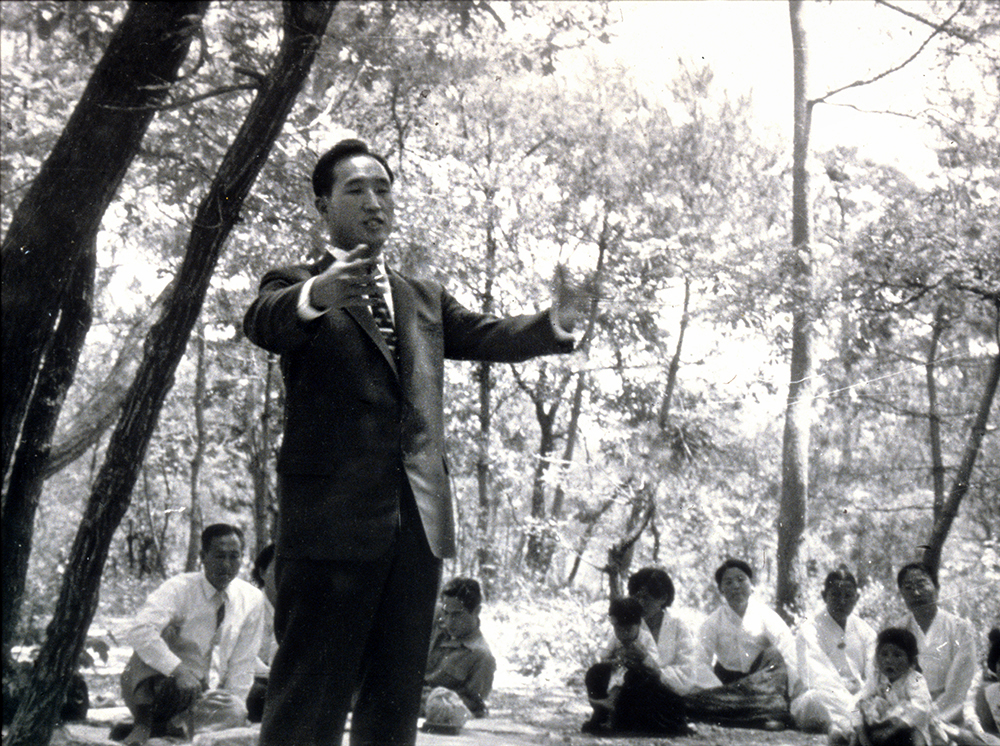
TF speaks outside 1960

By Tyler Hendricks

14_12_CfE_Tyler 10.55.08 pmOur Unification movement exemplifies two church models, and serves as a case study of their effect on church growth. Church growth has regular causes that can be discerned by examining churches that are growing. Church decline also has regular causes that can be discerned by examining churches that are shrinking. The defining characteristic of most growing churches is that they have one mission, that being evangelism, and congregational polity. Most shrinking churches have multiple missions and hierarchical polity.

For a church to have an evangelical mission means the church is organized to proclaim the good news (the “evangel”) and to bring others to salvation through it. Congregational polity means that the members of the local church own and govern the local church.

To have a hierarchical polity means that pastors are employed and directed by a central authority. Through the pastors, the central authority, which owns all properties, guides the planning, schedule, strategies, style, etc., for each congregation. Such churches tend to have multiple missions and pay little attention to evangelism.

Thesis #1: The Unification Church grew when and where it had an evangelical mission and congregational polity

Founding of the church: The Unification Church grew from one spirit-led man starting a local congregation. The church had an evangelical mission and congregational polity. He taught and preached a God-centered biblical vision for world transformation. He prayed incessantly. His mission began with a vision of Jesus; people who joined testified that it was the spirit world that led them to him. He loved and served others to bring them into his church, sleeping and eating little, giving up his family, worrying not about physical needs. That was how it started.

Continue Reading→

Good Leadership and Good Management: Why, How, What

8725865766_d7854991bc_k

By John Redmond

JohnRedmond2One of the great ironies of many successful religious movements is that they almost always start from failure — from a secular and mainstream point of view.  Christianity had its charismatic young leader crucified as a rabble rouser for tipping over the tables in the temple. Christians spent years in intellectual gymnastics explaining how the messiah was born an illegitimate child and killed as a criminal.

The Pilgrim Fathers were driven out of England, as were many of the other colonists who settled in the New World.  The Latter Day Saints (Mormons) were driven westward to the American desert to die, their founder lynched and religion mocked.

Yet these movements found multi-generational success in preaching, modeling and promoting the values and doctrines that gave them fulfillment and improved the culture around them.

This doesn’t happen by accident.  Successfully attracting and maintaining believers over multiple generations and changing the values of a culture requires a combination of good leadership and good management, and they are not the same thing.

Leadership requires communicating and validating a shared vision to a group of people you may or may not control. Reverend Moon could cast that vision, and many people, even those uncomfortable with his management style, could agree with that large and inclusive ideal and, perhaps more importantly, sense the heart behind it.

Management is the control of money, processes and people to achieve a desired product or outcome.  I’ve never been impressed with many Unification managers, who mostly mean well, but have little success or training from the real world on which to base their decisions.  They mostly default to Theory X management, micro-managing the behavior of their members rather than nurturing their goals, activities and creativity — or they swing to the other side, to religious-based trust and out-of-control management systems.  A movement with a great vision but poor management may succeed, but its progress is measured in millennia rather than years.

Continue Reading→

How America Can Help Reunite the Korean Peninsula

True Parents Kim

By Mark P. Barry

Mark Barry Photo 2In May, Mrs. Hak Ja Han Moon, speaking in New York, asked America to fulfill its role to help reunite the Korean Peninsula. She said:

…[T]he United States needs to fulfill its responsibility. In order to do so, Korea and the Korean Peninsula needs to become the top issue for the United States. …The homeland of God, Korea, needs to become one nation. And I hope the United States will stand on the forefront of this great task.

Now is the best opportunity yet for the U.S. to take forward-looking steps to make a breakthrough in Korea. August 15 is the 70th anniversary of Korean independence — and of the division of Korea, for which America bears a great share of responsibility. It is clear no other nation can make the difference in bringing about reunification.

Last month, the U.S. reestablished diplomatic relations with Cuba which were frozen in the Cold War since 1961. It also reached a nuclear agreement with another long-standing enemy, Iran, with the hope it will lead to an evolution in Iranian behavior. Now is the time for America to encourage, with seriousness and focus, the two Koreas and the regional powers — Japan, China and Russia — to establish permanent peace in the Peninsula.

On July 27, the three Korean War veterans in Congress, Rep. Charles Rangel, Rep. John Conyers, and Rep. Sam Johnson, introduced legislation calling for a formal end to the Korean War. As I wrote two years ago on this blog, a peace treaty is necessary to end the 1950-53 Korean War, and is the requisite first step toward eventual reunification. Little has changed since I wrote those words. But the opportunity for the American President to take bold actions in his final year and a half in office should not be missed.

Continue Reading→

Poetry: Encountering Philosophy and Life

Top Photo

By Susan Herrman

Susan HermannThese poems are dedicated to our True Parents of Heaven, Earth and Humankind, and reflect my pondering the lives of the philosophers I encountered in my studies at Barrytown College of UTS, especially from Dr. Keisuke Noda’s “Meaning of Life” class.

“To Season the Season of Change” was a long time contemplated — then sprung to life because a white blossom fell before me.  “To Mr. Camus, with love…” I wrote as I tried to take a positive view of the value of absurdity that Albert Camus posed. “Allegory of the Cubicle” was written as a modern-day twist to Plato’s “Allegory of the Cave” as it relates to my real-time life at my cubicle. “My Life” was written after contemplating my life, my encounter with the True Parents, and Moritz Schlick’s essay, “On the Meaning of Life.”  “Meaning” was written as part of the Senior Seminar class when I wrote poetry for the final class project.

To Season the Season of Change

The white petal falls from above

Like the snowflake a season ago

Like the leaf of autumn they dance and blow.

And yes, as the season of summer descends

With its radiant and intense beams of warmth and light

Shedding light to those below

How we must reverse our days and seasons

To come to our own true love’s season

Of radiant joy

Radiant light

Radiant love

So we must reverse our course to find our own unique season of life

Let me change my season now…

Continue Reading→

Cain and Abel Children: A Unification Parable

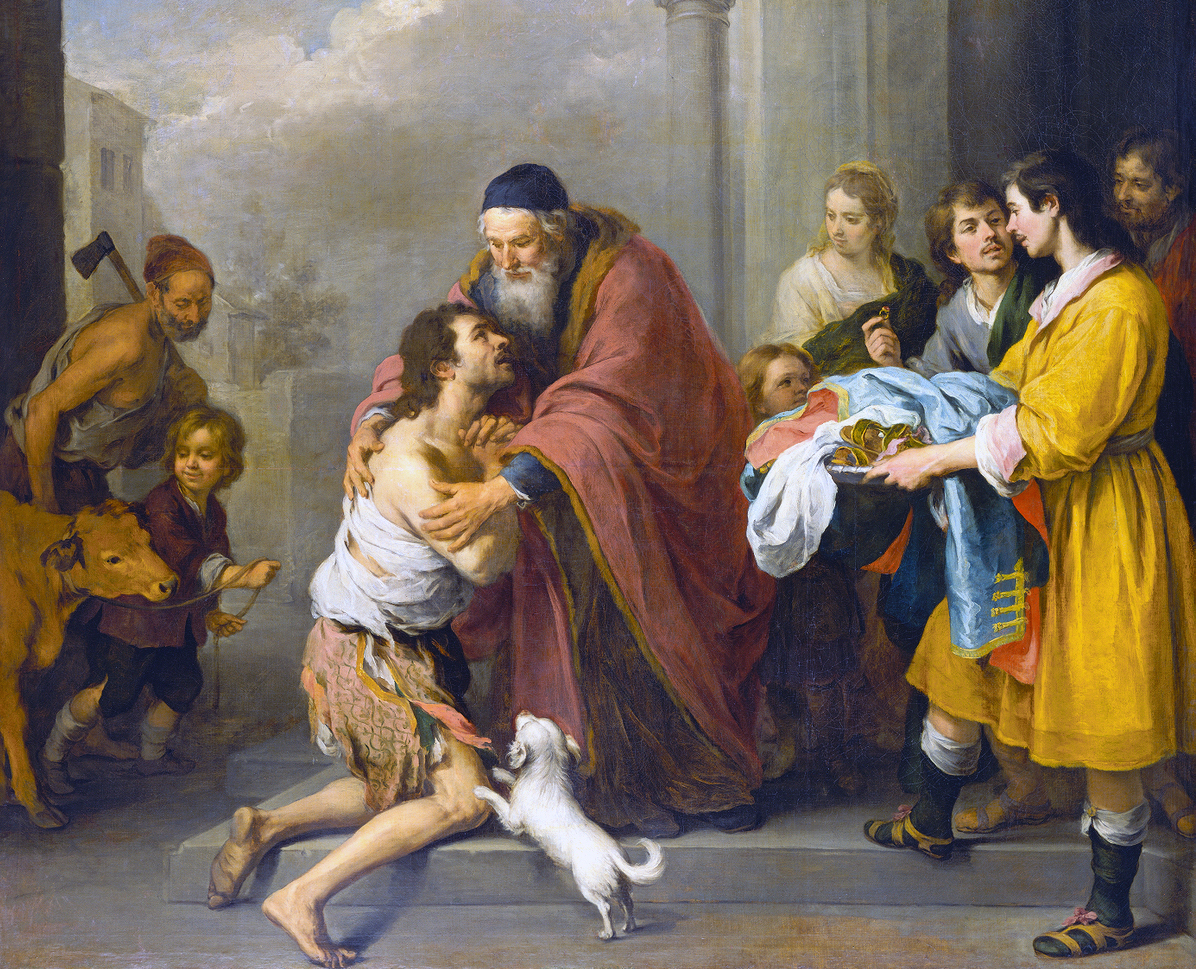
Bartolomé Esteban Murillo, The Return of the Prodigal Son, Spanish, 1617 - 1682, 1667/1670, oil on canvas, Gift of the Avalon Foundation

by Tyler Hendricks

14_12_CfE_Tyler 10.55.08 pmIn the “Cain children” vs. “Abel children” dichotomy, I’m of a mind that the primary category is “children.” Looking at Cain and Abel, the parents would say: “These are all my children. Some are older, some younger, some look more like me, some less, but we are one family and they all receive my inheritance.” Thus I apply the family paradigm from the parents’ viewpoint, rather than as we usually do, from a sibling (rivalry) point of view. I’m also of a mind to bring out the virtues and responsibilities of Cain more than usual.

The parable of the prodigal son (Luke 15:11-32) is instructive. Here, Abel took the inheritance, abandoned his father and wasted it in a self-centered life. But the spark of God within him woke him up; he realized his abject status as a sinner and returned to his father, ready to be a servant of servants. Based on this condition, the father bestowed blessings upon him. On the other hand, Cain served his father faithfully, building up the father’s fortune. He did not share the father’s willingness to bless Abel. But the father reached out to him and told him that all that was the father’s belonged to him and encouraged him to rejoice.

This reminds me of our relationship with True Parents over the years. We Cain children worked so hard, fundraising, witnessing, teaching, sleeping little, having nothing. We in New York would rise well before dawn on Sunday mornings to attend True Father’s sermons at Belvedere, only to get chastised for being sinners. I would think to myself, “But Father, we’re your children who are here attending you! What about those who didn’t even come here?” In the back of my mind was, “Father, you should be praising us, and chastising those who didn’t come.”

I was wise enough to realize a bit of what was going on, and now I’d like to expand upon that. We were True Parents’ Cain children. There’s one important distinction between their Cain children and Abel children: the Cain children were a lot older and so could serve as object partners doing the work with True Parents. We were young to Father, but to the Abel children, the biological children, we were a bunch of old folks running around exhausting ourselves in a missionary life, often joyful, sometimes resentful, but obediently lining up to bow in front of their parents. We had so many complicated feelings toward True Parents, and the Abel children, whose feelings for True Parents were simpler at first, could see it and feel it.

Continue Reading→

Towards the Emergence of Original Eve

3867417936_ef64c33d52_o

By Alison Wakelin

Alison WakelinIn pagan religions, women were held in high esteem, with men and women holding rites and ceremonies honoring the Earth Goddess. But looking more closely, we see humans were still living almost as part of creation, like a superior animal, with no recognition of their divine natures, and little realistic concept of a God who created out of love transcending nature itself. Tracing the course of monotheistic religions as God’s attempt to establish the spiritual nature of the human being, we see how Unificationism has brought a total break with the past, in honoring the nature of the divine feminine as an equal and necessary expression of God.

Judaism, Christianity and Islam were established on the basis of male superiority, females, having inherited Eve’s inability to think for herself, considered incapable of anything other than raising children and supporting their husbands. Thus each monotheistic religion which preceded Unificationism and laid the foundation for today left Mother God in some way unempowered.

To sum up the achievements of the messianic mission, we must evaluate clearly the foundation for the world to receive not just a new Adam, but also a new Eve.

In Principled terminology, Eve also acquired two natures as a result of the fall, Eve and Fallen Eve, just as Adam had two natures. Notice that neither Eve nor Fallen Eve is actually the same as Original Eve. Original Eve still has to be explored, a happy quest in which we will all be involved.

Therefore, Eve’s task is also to set up the conditions for the Foundations of Faith and Substance. For women, this primarily involves healing, because that is the uniqueness brought to humanity by women, their unique expression of Mother God, although Eve’s emergence will also be accompanied by the expression of Eve’s intellect and subjectivity in ways history has been unable to imagine.

Continue Reading→

Website Built with WordPress.com.

Up ↑