Evangelical, Congregational and Blessed

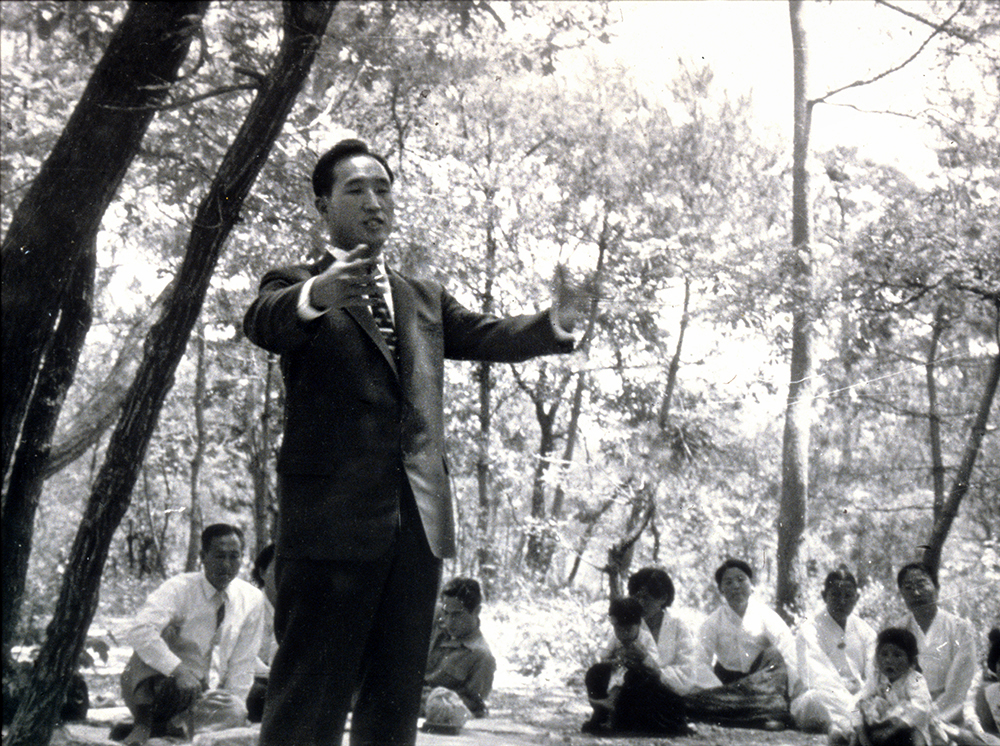
TF speaks outside 1960

By Tyler Hendricks

14_12_CfE_Tyler 10.55.08 pmOur Unification movement exemplifies two church models, and serves as a case study of their effect on church growth. Church growth has regular causes that can be discerned by examining churches that are growing. Church decline also has regular causes that can be discerned by examining churches that are shrinking. The defining characteristic of most growing churches is that they have one mission, that being evangelism, and congregational polity. Most shrinking churches have multiple missions and hierarchical polity.

For a church to have an evangelical mission means the church is organized to proclaim the good news (the “evangel”) and to bring others to salvation through it. Congregational polity means that the members of the local church own and govern the local church.

To have a hierarchical polity means that pastors are employed and directed by a central authority. Through the pastors, the central authority, which owns all properties, guides the planning, schedule, strategies, style, etc., for each congregation. Such churches tend to have multiple missions and pay little attention to evangelism.

Thesis #1: The Unification Church grew when and where it had an evangelical mission and congregational polity

Founding of the church: The Unification Church grew from one spirit-led man starting a local congregation. The church had an evangelical mission and congregational polity. He taught and preached a God-centered biblical vision for world transformation. He prayed incessantly. His mission began with a vision of Jesus; people who joined testified that it was the spirit world that led them to him. He loved and served others to bring them into his church, sleeping and eating little, giving up his family, worrying not about physical needs. That was how it started.

Continue Reading→

Good Leadership and Good Management: Why, How, What

8725865766_d7854991bc_k

By John Redmond

JohnRedmond2One of the great ironies of many successful religious movements is that they almost always start from failure — from a secular and mainstream point of view.  Christianity had its charismatic young leader crucified as a rabble rouser for tipping over the tables in the temple. Christians spent years in intellectual gymnastics explaining how the messiah was born an illegitimate child and killed as a criminal.

The Pilgrim Fathers were driven out of England, as were many of the other colonists who settled in the New World.  The Latter Day Saints (Mormons) were driven westward to the American desert to die, their founder lynched and religion mocked.

Yet these movements found multi-generational success in preaching, modeling and promoting the values and doctrines that gave them fulfillment and improved the culture around them.

This doesn’t happen by accident.  Successfully attracting and maintaining believers over multiple generations and changing the values of a culture requires a combination of good leadership and good management, and they are not the same thing.

Leadership requires communicating and validating a shared vision to a group of people you may or may not control. Reverend Moon could cast that vision, and many people, even those uncomfortable with his management style, could agree with that large and inclusive ideal and, perhaps more importantly, sense the heart behind it.

Management is the control of money, processes and people to achieve a desired product or outcome.  I’ve never been impressed with many Unification managers, who mostly mean well, but have little success or training from the real world on which to base their decisions.  They mostly default to Theory X management, micro-managing the behavior of their members rather than nurturing their goals, activities and creativity — or they swing to the other side, to religious-based trust and out-of-control management systems.  A movement with a great vision but poor management may succeed, but its progress is measured in millennia rather than years.

Continue Reading→

How America Can Help Reunite the Korean Peninsula

True Parents Kim

By Mark P. Barry

Mark Barry Photo 2In May, Mrs. Hak Ja Han Moon, speaking in New York, asked America to fulfill its role to help reunite the Korean Peninsula. She said:

…[T]he United States needs to fulfill its responsibility. In order to do so, Korea and the Korean Peninsula needs to become the top issue for the United States. …The homeland of God, Korea, needs to become one nation. And I hope the United States will stand on the forefront of this great task.

Now is the best opportunity yet for the U.S. to take forward-looking steps to make a breakthrough in Korea. August 15 is the 70th anniversary of Korean independence — and of the division of Korea, for which America bears a great share of responsibility. It is clear no other nation can make the difference in bringing about reunification.

Last month, the U.S. reestablished diplomatic relations with Cuba which were frozen in the Cold War since 1961. It also reached a nuclear agreement with another long-standing enemy, Iran, with the hope it will lead to an evolution in Iranian behavior. Now is the time for America to encourage, with seriousness and focus, the two Koreas and the regional powers — Japan, China and Russia — to establish permanent peace in the Peninsula.

On July 27, the three Korean War veterans in Congress, Rep. Charles Rangel, Rep. John Conyers, and Rep. Sam Johnson, introduced legislation calling for a formal end to the Korean War. As I wrote two years ago on this blog, a peace treaty is necessary to end the 1950-53 Korean War, and is the requisite first step toward eventual reunification. Little has changed since I wrote those words. But the opportunity for the American President to take bold actions in his final year and a half in office should not be missed.

Continue Reading→

Poetry: Encountering Philosophy and Life

Top Photo

By Susan Herrman

Susan HermannThese poems are dedicated to our True Parents of Heaven, Earth and Humankind, and reflect my pondering the lives of the philosophers I encountered in my studies at Barrytown College of UTS, especially from Dr. Keisuke Noda’s “Meaning of Life” class.

“To Season the Season of Change” was a long time contemplated — then sprung to life because a white blossom fell before me.  “To Mr. Camus, with love…” I wrote as I tried to take a positive view of the value of absurdity that Albert Camus posed. “Allegory of the Cubicle” was written as a modern-day twist to Plato’s “Allegory of the Cave” as it relates to my real-time life at my cubicle. “My Life” was written after contemplating my life, my encounter with the True Parents, and Moritz Schlick’s essay, “On the Meaning of Life.”  “Meaning” was written as part of the Senior Seminar class when I wrote poetry for the final class project.

To Season the Season of Change

The white petal falls from above

Like the snowflake a season ago

Like the leaf of autumn they dance and blow.

And yes, as the season of summer descends

With its radiant and intense beams of warmth and light

Shedding light to those below

How we must reverse our days and seasons

To come to our own true love’s season

Of radiant joy

Radiant light

Radiant love

So we must reverse our course to find our own unique season of life

Let me change my season now…

Continue Reading→

Cain and Abel Children: A Unification Parable

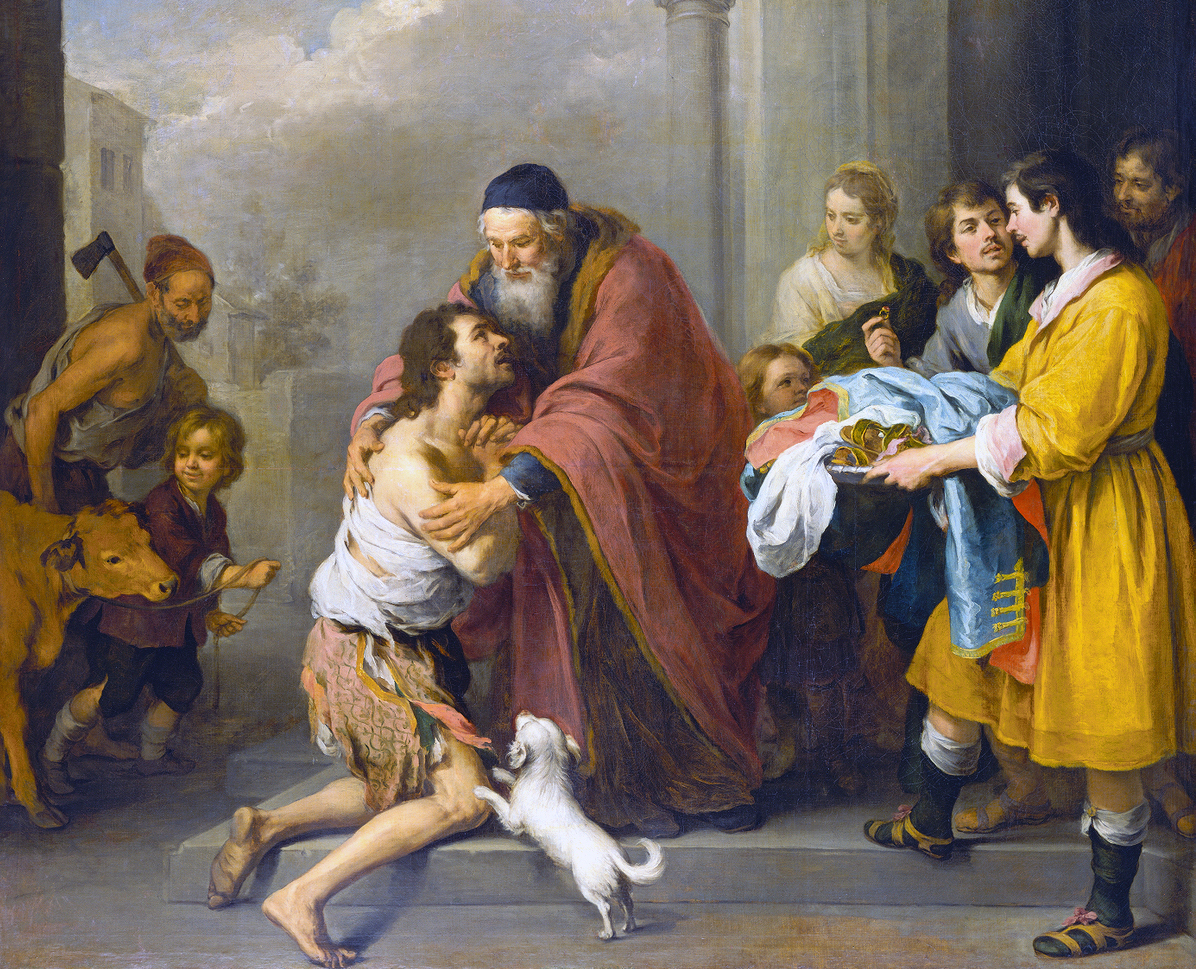
Bartolomé Esteban Murillo, The Return of the Prodigal Son, Spanish, 1617 - 1682, 1667/1670, oil on canvas, Gift of the Avalon Foundation

by Tyler Hendricks

14_12_CfE_Tyler 10.55.08 pmIn the “Cain children” vs. “Abel children” dichotomy, I’m of a mind that the primary category is “children.” Looking at Cain and Abel, the parents would say: “These are all my children. Some are older, some younger, some look more like me, some less, but we are one family and they all receive my inheritance.” Thus I apply the family paradigm from the parents’ viewpoint, rather than as we usually do, from a sibling (rivalry) point of view. I’m also of a mind to bring out the virtues and responsibilities of Cain more than usual.

The parable of the prodigal son (Luke 15:11-32) is instructive. Here, Abel took the inheritance, abandoned his father and wasted it in a self-centered life. But the spark of God within him woke him up; he realized his abject status as a sinner and returned to his father, ready to be a servant of servants. Based on this condition, the father bestowed blessings upon him. On the other hand, Cain served his father faithfully, building up the father’s fortune. He did not share the father’s willingness to bless Abel. But the father reached out to him and told him that all that was the father’s belonged to him and encouraged him to rejoice.

This reminds me of our relationship with True Parents over the years. We Cain children worked so hard, fundraising, witnessing, teaching, sleeping little, having nothing. We in New York would rise well before dawn on Sunday mornings to attend True Father’s sermons at Belvedere, only to get chastised for being sinners. I would think to myself, “But Father, we’re your children who are here attending you! What about those who didn’t even come here?” In the back of my mind was, “Father, you should be praising us, and chastising those who didn’t come.”

I was wise enough to realize a bit of what was going on, and now I’d like to expand upon that. We were True Parents’ Cain children. There’s one important distinction between their Cain children and Abel children: the Cain children were a lot older and so could serve as object partners doing the work with True Parents. We were young to Father, but to the Abel children, the biological children, we were a bunch of old folks running around exhausting ourselves in a missionary life, often joyful, sometimes resentful, but obediently lining up to bow in front of their parents. We had so many complicated feelings toward True Parents, and the Abel children, whose feelings for True Parents were simpler at first, could see it and feel it.

Continue Reading→

Towards the Emergence of Original Eve

3867417936_ef64c33d52_o

By Alison Wakelin

Alison WakelinIn pagan religions, women were held in high esteem, with men and women holding rites and ceremonies honoring the Earth Goddess. But looking more closely, we see humans were still living almost as part of creation, like a superior animal, with no recognition of their divine natures, and little realistic concept of a God who created out of love transcending nature itself. Tracing the course of monotheistic religions as God’s attempt to establish the spiritual nature of the human being, we see how Unificationism has brought a total break with the past, in honoring the nature of the divine feminine as an equal and necessary expression of God.

Judaism, Christianity and Islam were established on the basis of male superiority, females, having inherited Eve’s inability to think for herself, considered incapable of anything other than raising children and supporting their husbands. Thus each monotheistic religion which preceded Unificationism and laid the foundation for today left Mother God in some way unempowered.

To sum up the achievements of the messianic mission, we must evaluate clearly the foundation for the world to receive not just a new Adam, but also a new Eve.

In Principled terminology, Eve also acquired two natures as a result of the fall, Eve and Fallen Eve, just as Adam had two natures. Notice that neither Eve nor Fallen Eve is actually the same as Original Eve. Original Eve still has to be explored, a happy quest in which we will all be involved.

Therefore, Eve’s task is also to set up the conditions for the Foundations of Faith and Substance. For women, this primarily involves healing, because that is the uniqueness brought to humanity by women, their unique expression of Mother God, although Eve’s emergence will also be accompanied by the expression of Eve’s intellect and subjectivity in ways history has been unable to imagine.

Continue Reading→

Same-Sex Marriage: A Unificationist Response

Gay-marriage-ruling-e1435341862437

By Robert Beebe

Dr BeebeSame-sex marriage is now the law of the land, thanks to the recent 5-4 ruling by the U.S. Supreme Court. Despite 30 states enshrining in their constitutions that marriage was the union of one man and one woman through the combined votes of 50 million people, all this was swept away in two years largely by federal court rulings that made same-sex marriage legal in 37 states, culminating in the Supreme Court decision. Along the way, a majority of Americans are said to now support same-sex marriage. The culture war is over, advocates say. The traditional view of marriage has been cast aside.

All this has occurred not for want of effort on the part of traditional marriage supporters. The National Organization for Marriage, the Family Research Council, and other Christian-based groups have fought tooth-and-nail for many years to prevent what has just happened. Despite their confidence in their cause, and believing that God was on their side, they ended up fighting a losing battle. How did this happen?

Looking back, it seems now an inevitable result of a half-century of cultural change beginning with the sexual revolution of the 1960s. Traditional marriage lost its honored place in American culture long ago when the divorce rate began to skyrocket towards 50%, where it remains today. What are we to expect when millions of children fail to experience the benefits of traditional marriage in their own homes during their formative years? Why should we be surprised when, as teens and young adults, they begin to look elsewhere and experiment in unorthodox ways in their desire to find love? The seeds for legalization of same-sex marriage can be found in the breakdown of the traditional two-parent family.

This has been accompanied by the indoctrination of our young people by a public school system that promotes in the name of diversity not only tolerance but the celebration of all sorts of lifestyles and personal expression. The Judeo-Christian values that once provided the moral foundation for our culture and informed the nation’s education system have been replaced by a godless secular perspective in which anything goes. From this new perspective, once accepted traditional values are now regarded as oppressive and bigoted. Having breathed this atmosphere day-after-day in the public schools, many of our own children have adopted the values of the popular secular culture.

Continue Reading→

Will We Ever Walk Justly?

Mother Emanuel

By Kathy Winings

kathy-winings-2Headlines across the United States on June 18 blared the news of yet another shooting. The evening before, 21-year-old Dylann Roof walked into the historic Emanuel A.M.E. Church in Charleston, South Carolina, spoke with its pastor, Rev. Clementa Pinckney, and participated in the weekly Bible study that had just begun. Towards the end of the session, Roof rose uttering racist remarks, pulled out a gun and began firing. He killed nine people, including Pinckney; three survived. The shooting has been called a hate crime, and Roof reportedly left a manifesto indicating he wanted to foment a race war.

The shooting is just another example of acts of injustice that haunt us every day. One would think that in the 21st century, amid cries for greater peace and harmony, and with a more educated populace, that incidents of injustice would be lessened and efforts to bring about a more just society would be more successful. Yet we continue to live with a seemingly endless parade of justice issues coming to the fore on a daily basis. We read of religious radicalism and fanaticism, poverty, starvation, human trafficking, global warfare, violence, sexual abuse, racial discrimination, internecine fighting — to name just a few. With all of our knowledge, wisdom, wealth, understanding of history, and our sophistication, why is it still so difficult to achieve a more just and loving world? What are we missing?

As Unificationists, we turn to Unification thought and theology to try to make sense of injustice and to answer the question of what it takes to live justly in the 21st century. However, Unification thought and theology are limited in terms of presenting a practical answer as to why it is so difficult to create a just world. At best, Unification thought and theology use only broad strokes to meet this challenge by presenting theories concerning ontology, original human nature, universal values, ethics, order and equality. Therefore, our challenge is to take these theoretical concepts and develop them to give a more effective practical understanding of how to address injustice.

Continue Reading→

The Misinterpretation of Emperor Constantine’s Vision and Its Consequences

Konstantin's vision

By Rohan Stefan Nandkisore

EditorEmperor Constantine’s victory against Maxentius in 312 AD is commonly understood as the first battle under the banner of Christianity and seen as a major shift from its status as a persecuted religion of outlaws to the established power that would reign for over a millennia in the world. But is this really the case?

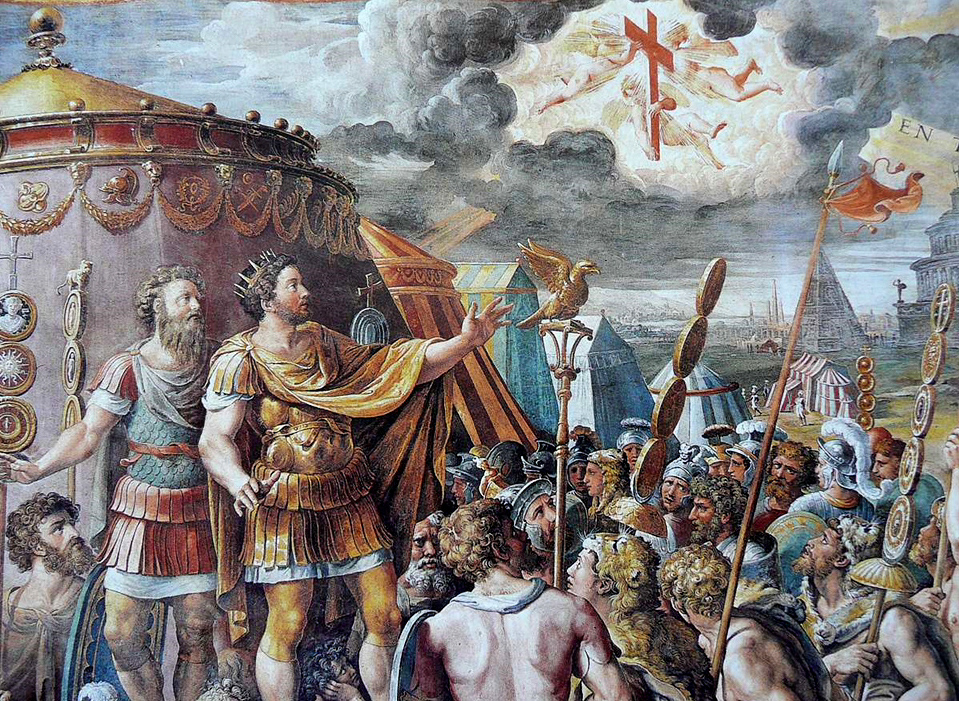
Emperor Constantine had a vision of a cross in the sky. This was interpreted by his advisors as a divine sign of good fortune in coming battle. The cross as a symbol of power in battle originated here. Until then, the cross and more so, the letter “p,” standing for pax or “peace,” were symbols for Christianity.

In still earlier times, the fish was the secret symbol for Christians. In the Greek language, ichthys was the word for fish. Each letter was the beginning of this message: Iesous Christos theou yios soter, “Jesus Christ, son of God, Savior.”

Until Constantine, bloodshed was not caused by Christians. The idea to shed blood in the name of Christ, in the sense to harm others, was alien and not supported by its founder — quite the contrary. As a result of its way of life, this religion of persecuted outlaws eventually brought the Roman Empire to its knees. It did so without military power but through devotion to Christ and by filling the cup of indemnity until finally released. This was perhaps the most honorable victory in Christian history.

The Vikings and the adaptation of Constantine’s conquest

When Reverend Moon travelled through Europe in 2005 (then banned from the Schengen Area), he strongly addressed the Viking mentality of Europeans. At that time, I did not get it, because by my understanding, the Viking age was between 800 to 1000 AD. However, this applied only to the well-known Viking raids that occurred in Western Europe mainly from Norway. In the eastern part of Europe, Vikings travelled as traders and settlers along the rivers, particularly in Russia, until they met Muslim communities on the shores of the Mediterranean. According to the most prevalent theory, the name of the Rus‍ ’ people is derived from an Old Norse term for “the men who row.”

Continue Reading→

Website Built with WordPress.com.

Up ↑