The Mission Butterfly of Early Christianity and the Nature of Unificationism

CrossShadow

By Rohan Stefan Nandkisore

EditorLooking at history, we see that the rise of democratic societies — some of which even base their constitutions on the ideology of Jesus Christ — has brought about freedom on a scale never before experienced. Yet, we also witness an erosion of those highly treasured values.

Countless people, mainly Christians, died to attain these values that we take for granted today; this includes underground missionaries of the Unification Church in the former Soviet Union and East European countries, whose sacrificial missions sometimes led to imprisonment and even death, and was referred to as “mission butterfly.”

We need to revitalize these virtues as expressed in Reverend Moon’s peace messages in order to not lose them. As a journalist, I discovered interesting aspects of early Christianity that offer valuable lessons from the past.

There is a basilica in Fulda, Germany, which contains the relics of Boniface, given the honorable title “Bishop of the Germans.” I was wondering for a long time how come a missionary from Wessex (England) Christianized the German lands in the 7th century? Geographically, Britain is much further from Rome and the Mediterranean than Germany.

The answer to this riddle dates back to the times of Emperor Augustus, 9 A.D., during the childhood of Jesus. Augustus mourning “Varus, Varus, give back my legions” is still remembered today. Arminius, a Cherusk, caused the annihilation of three Roman legions in the Teutoburger forest. Subsequently, the Romans withdrew from large areas of German lands and never returned. As a result, it did not become Christianized, but Britain did after it came under the control of the Roman Empire at least until the Hadrian fortress fell.

Continue Reading→

“Bridge of Spies” and Teachable Moments

By Kathy Winings

kathy-winings-2I was just a small child when the Berlin Wall and Cold War took center stage in the news. Though my parents did not speak of such things while I was growing up, my father did talk about the “Red Scare” and “those Communists.” Of course, I would not understand what that meant until I was much older. I could not even imagine the level of fear that many people must have felt during this period of American history with its talk of spies and counterespionage.

I do remember hearing about a pilot, Francis Gary Powers, who was shot down and captured by the Russians. But I did not know the full story and had no idea of the maelstrom that surrounded this episode in history – at least not until I saw “Bridge of Spies.”

Director Steven Spielberg, together with writers Matt Charman, Ethan and Joel Coen, has captured the intense feelings of the Cold War era and the issues surrounding the trial of a real-life Russian spy, an American U2 spy plane pilot, and an American student caught on the wrong side of the Berlin Wall in his latest movie.

This excellent film tells the story of a successful Brooklyn, NY, insurance attorney, James B. Donovan (played by Tom Hanks), who is asked by the U.S. government to defend captured Soviet spy Rudolf Abel, who was tried for espionage in 1957. In the minds of many Americans, Abel is the personification of all that was evil in the Soviet regime. In this post-atomic bomb era of fear, the average American citizen is certain their government will do the right thing and simply sentence Abel to death, teaching the Russians a lesson they would never forget.

However, the American government sees it differently. As a potential powder keg, it is believed Abel should receive the best defense possible, or at least have the appearance of a strong defense to guard against any retaliation from Russia. What the government does not account for is Donovan’s strong sense of right and wrong. Though it is a foregone conclusion Abel will be found guilty, Donovan has the foresight to convince the presiding judge to sentence Abel to prison rather than condemn him to death.

Continue Reading→

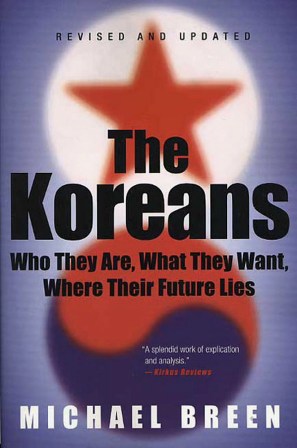
Book Review: “The Koreans: Who They Are, What They Want, Where Their Future Lies”

9780312326098

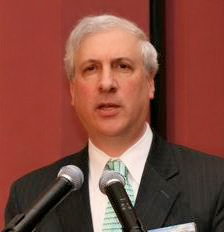
by Mark P. Barry

Mark Barry Photo 2The Koreans: Who They Are, What They Want, Where Their Future Lies, rev. ed., by Michael Breen, New York: Thomas Dunne Books/St. Martin’s Griffin, 2004. Adapted from the Journal of Unification Studies, vol. VI, 2004-2005, pp. 165-68.

Although originally targeted for foreign business readers, Michael Breen’s The Koreans has emerged as a modern-day classic on the Korean character and culture. It is often recommended by Korean studies scholars, alongside such earlier general works as the late Donald S. Macdonald’s Koreans: Contemporary Politics and Society (now in its third edition, revised by Donald Clark). In its 1999 Korean translation from the original 1998 UK edition, The Koreans rocketed to the top ten list of Korea’s bestsellers, revealing Koreans’ own enthusiasm to understand themselves from an outsider’s perspective. The U.S. hardcover edition also appeared in 1999, and the 2004 paperback edition reviewed here is slightly revised with a new chapter on events since 2000.

Breen, a British journalist, originally went to South Korea as The Washington Times’ Seoul correspondent. He ended up living there, during which time he also served for three years as president of the Seoul Foreign Correspondents Club, and wrote for The Guardian and The Times of London. He later became managing director of the Seoul office of public relations firm Merit/Burson-Marsteller, and now runs his own company, Insight Communications Consultants.

Unificationists will remember him authoring in 1997 the meticulously researched Sun Myung Moon: The Early Years, 1920-53, based on in-depth interviews with early followers of Reverend Moon. No book has appeared in English since to rival it.

Continue Reading→

The Long Trek Home: Resolving the European Refugee Crisis

Refugees in Hungary2

by Kathy Winings

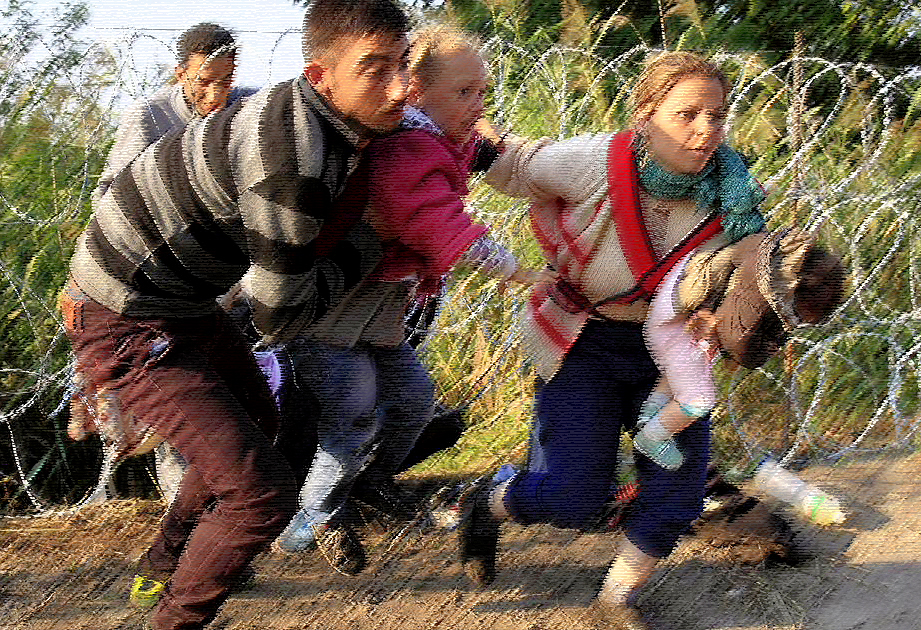
kathy-winings-2Thirty thousand, 12,000, 21,000, 3,000, 150,000, 442,000. . . These are just some of the refugee numbers connected with the current humanitarian crisis facing Europe. 30,000 – the number of refugees who have entered Croatia. 12,000 – the number of migrants who have entered Slovenia. 21,000 – the number who have been accepted by Sweden.  3,000 – the number who have drowned at sea while attempting to cross into Europe. 150,000 – the number who made it to Greece. The last number, 442,000 – the number of refugees who have arrived in Europe by boat.

Thousands are continuing to cross borders into Europe on a daily basis. Germany expects 800,000 migrants to reach its borders by year’s end. Each number represents a hope,  dream and vision for a better life, one safe from physical and emotional violence.  Even the United States is considering raising its annual ceiling of 70,000, the total number of refugees it accepts on an annual basis, to 85,000 in 2016 and 100,000 in 2017.  But that is a drop in the bucket compared with the vast numbers of men, women and children fleeing to Europe from Syria, Iraq, Libya, Sudan, Eritrea, Nigeria, Afghanistan, Pakistan and elsewhere for a better life.

This is being hailed as a “humanitarian crisis of epic proportions.” What does it represent? What are the issues involved? Can it be effectively resolved? We have seen mass migrations before; what makes this one different?

First, this migration is occurring in the 21st century. It means more communication is taking place among the migrants by cellphones. As families and groups of migrants move, they are in constant contact with those who have gone before them, learning where to go, what to avoid and what to expect on the road ahead of them. Digital technology also gives them access to GPS, web maps and news.

Second, the reasons why people are migrating are diverse. Previous migrations were often defined by major or cataclysmic events such as war, devastating natural disasters or religious/cultural upheavals. This resulted in mass migrations defined by singular issues.

Continue Reading→

How America Can Help Reunite the Korean Peninsula

True Parents Kim

By Mark P. Barry

Mark Barry Photo 2In May, Mrs. Hak Ja Han Moon, speaking in New York, asked America to fulfill its role to help reunite the Korean Peninsula. She said:

…[T]he United States needs to fulfill its responsibility. In order to do so, Korea and the Korean Peninsula needs to become the top issue for the United States. …The homeland of God, Korea, needs to become one nation. And I hope the United States will stand on the forefront of this great task.

Now is the best opportunity yet for the U.S. to take forward-looking steps to make a breakthrough in Korea. August 15 is the 70th anniversary of Korean independence — and of the division of Korea, for which America bears a great share of responsibility. It is clear no other nation can make the difference in bringing about reunification.

Last month, the U.S. reestablished diplomatic relations with Cuba which were frozen in the Cold War since 1961. It also reached a nuclear agreement with another long-standing enemy, Iran, with the hope it will lead to an evolution in Iranian behavior. Now is the time for America to encourage, with seriousness and focus, the two Koreas and the regional powers — Japan, China and Russia — to establish permanent peace in the Peninsula.

On July 27, the three Korean War veterans in Congress, Rep. Charles Rangel, Rep. John Conyers, and Rep. Sam Johnson, introduced legislation calling for a formal end to the Korean War. As I wrote two years ago on this blog, a peace treaty is necessary to end the 1950-53 Korean War, and is the requisite first step toward eventual reunification. Little has changed since I wrote those words. But the opportunity for the American President to take bold actions in his final year and a half in office should not be missed.

Continue Reading→

The Misinterpretation of Emperor Constantine’s Vision and Its Consequences

Konstantin's vision

By Rohan Stefan Nandkisore

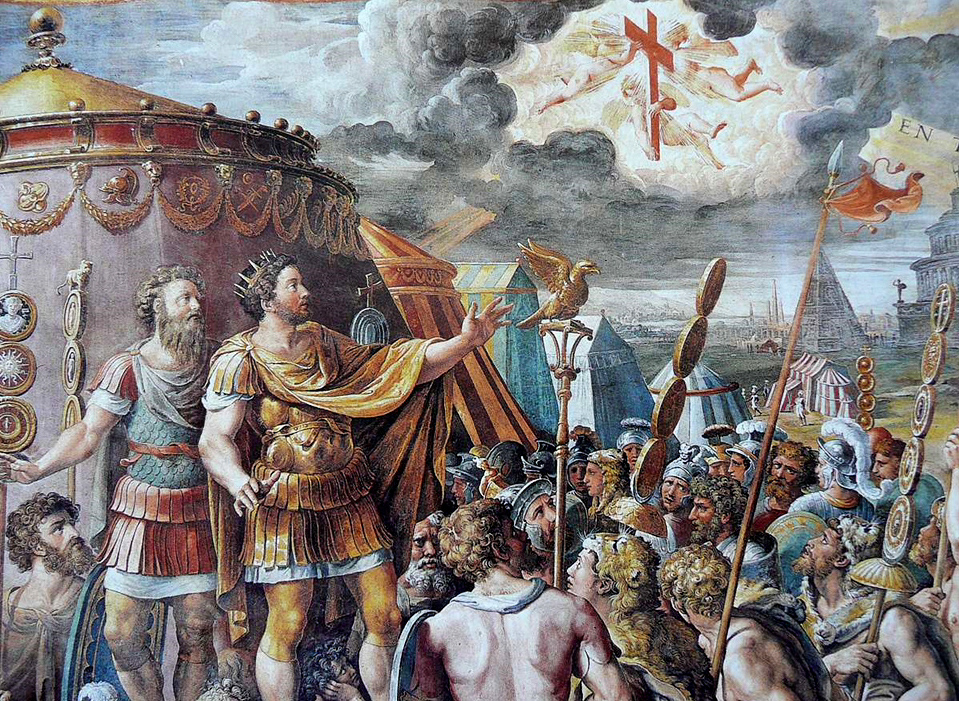
EditorEmperor Constantine’s victory against Maxentius in 312 AD is commonly understood as the first battle under the banner of Christianity and seen as a major shift from its status as a persecuted religion of outlaws to the established power that would reign for over a millennia in the world. But is this really the case?

Emperor Constantine had a vision of a cross in the sky. This was interpreted by his advisors as a divine sign of good fortune in coming battle. The cross as a symbol of power in battle originated here. Until then, the cross and more so, the letter “p,” standing for pax or “peace,” were symbols for Christianity.

In still earlier times, the fish was the secret symbol for Christians. In the Greek language, ichthys was the word for fish. Each letter was the beginning of this message: Iesous Christos theou yios soter, “Jesus Christ, son of God, Savior.”

Until Constantine, bloodshed was not caused by Christians. The idea to shed blood in the name of Christ, in the sense to harm others, was alien and not supported by its founder — quite the contrary. As a result of its way of life, this religion of persecuted outlaws eventually brought the Roman Empire to its knees. It did so without military power but through devotion to Christ and by filling the cup of indemnity until finally released. This was perhaps the most honorable victory in Christian history.

The Vikings and the adaptation of Constantine’s conquest

When Reverend Moon travelled through Europe in 2005 (then banned from the Schengen Area), he strongly addressed the Viking mentality of Europeans. At that time, I did not get it, because by my understanding, the Viking age was between 800 to 1000 AD. However, this applied only to the well-known Viking raids that occurred in Western Europe mainly from Norway. In the eastern part of Europe, Vikings travelled as traders and settlers along the rivers, particularly in Russia, until they met Muslim communities on the shores of the Mediterranean. According to the most prevalent theory, the name of the Rus‍ ’ people is derived from an Old Norse term for “the men who row.”

Continue Reading→

Going Over the Number 70 in Divided Korea

6245-Snap Art

By Mark P. Barry

Mark Barry Photo 2This year marks 70 years since the division of Korea. From August 1945, the Korean Peninsula has been split between a communist North and democratic South. Unificationists know Reverend Moon foretold, exemplified by a 1985 conference, that the Soviet Union would collapse after going over the number 70, figured from 1917. While it took four more years, highlighted by the Soviet experiment with perestroika and glasnost, President Gorbachev resigned and dissolved the USSR on Christmas Day 1991.

With the Unification movement focused on Vision 2020, it begs the question: “Can the Korean Peninsula be reunified by the end of this decade?” or, at least, “Will the two Koreas develop a peaceful and constructive relationship, ending their decades of hostility and division?”

East Asia knows the special significance of 2015. For Korea, China, and Southeast Asia, it is a year to commemorate their liberation from Japanese military occupation. For Korea, 1945 also marked the end of 40 years of Japanese colonial domination and annexation. For Japan, as it has already experienced in recent months, this year has been a painful reminder of its wartime legacy in Asia, and the expectations of its victims of 70 years ago for Japan to sincerely apologize and take responsibility for the profound harm it caused. It’s also a time when East Asia is reacting to China’s bid for regional hegemony, given it recently became the world’s largest economy.

For Koreans north and south, this year also marks the 15th anniversary of the historic summit meeting between the North’s Kim Jong Il and the South’s Kim Dae Jung. Both leaders are no longer alive, but Kim Dae Jung’s widow is expected to make a goodwill visit to Pyongyang later this month to commemorate the June 2000 summit. Sadly, little progress was made between the two Koreas after that first summit, and in particular since 2010, their relations have gone steadily downhill.

The first commemoration of the 70th anniversary of the end of World War II took place May 9 in Moscow, where Russian President Vladimir Putin hosted UN Secretary General Ban Ki-moon, China’s President Xi Jinping, and other world leaders to mark the Allied victory in Europe. Up until the last moment, it was expected that current North Korean leader, Kim Jong Un, would attend; but he canceled his trip.*

Continue Reading→

Chávez’s Legacy and Worsening Conditions in Venezuela

Fila-supermercado-Foto-Andres-Veliz_ELPIMA20130109_0519_8

Venezuelans hoarding cornmeal flour.

By David Stewart

David Stewart_edited-1I had been in Caracas for just a few days in June when a friend called me and excitedly said, “I have good news. They are selling sugar here and each person can buy four kilos. Come quickly with whoever is at home.” It was a 20 minute bus ride away and then we had to wait over an hour in line. But one spurns such opportunities at one’s peril in Venezuela in recent years.

I never had this experience when living in Caracas in the late 1990s, but this is now the norm. When visiting in March, I asked a clearly irritated mother, just leaving a supermarket, how long she and her young son had waited to buy harina pan, the cornmeal flour used to prepare the Venezuelan staple arepa. “Three and a half hours” she snapped. I could only sympathize and decided not to wait in line myself. The shops are now forbidden to sell this most essential product to anyone under 18, as, with its sale being rationed on the rare occasions it can be bought, whole families wait together in line to maximize their purchasing power.

The harina pan and sugar story is the same for toilet paper, milk, coffee — indeed over 25% of all necessary staples are rationed, being rarely available, according to the last scarcity figures published by the central bank in January. Even the government admits that the poverty rate leapt from 21% to 27% last year, mainly because incomes failed to keep up with soaring inflation, now officially over 60%. The economy is set to shrink this year by at least 1% according to even the government’s predictions. Yields on Venezuela’s sovereign debt skyrocketed in the past year, to just under 14%, tops among 50 emerging markets tracked by JPMorgan Chase. The latest hard-to-find item — coffins!

Continue Reading→

BBC Interview: Twenty Years After the Death of Kim Il Sung

p022c23m

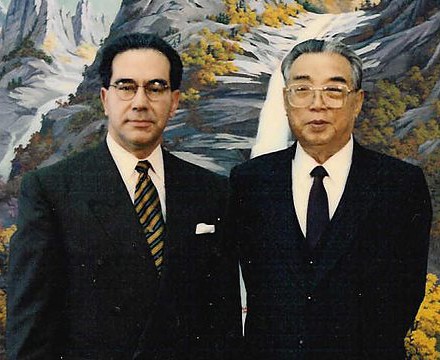
 Dr. Antonio Betancourt meeting President Kim Il Sung in January 1994.

Kim Il Sung passed away 20 years ago on July 8. The BBC World Service broadcast an interview (click here to listen to the full interview) with Unificationist Dr. Antonio Betancourt on meeting President Kim five times (on the foundation of Reverend and Mrs. Moon’s visit with the North Korean leader in 1991), being in Pyongyang when he died, and, with Dr. Bo Hi Pak, attending Kim’s state funeral. Dr. Betancourt is currently Director, Office of Peace and Security Affairs, UPF International, in Washington, D.C., and Secretary General of the Summit Council for World Peace. A nine-minute podcast of the BBC interview may also be downloaded here.

In an analysis of the missed opportunities 20 years ago upon Kim’s passing, AU Blog Managing Editor Dr. Mark P. Barry posted an essay on NKNews.org, the leading site for researchers and journalists on North Korea, that provides an overview of what could have happened on the Korean Peninsula over the past two decades. Dr. Betancourt provided valuable assistance in the essay, and a great debt of gratitude is owed to Dr. Bo Hi Pak for his unique insights in Chapter 21 of Messiah: My Testimony to Rev. Sun Myung Moon, Vol. II. London’s The Guardian newspaper picked up Dr. Barry’s article days later, providing a vastly wider online readership, and he was also interviewed at length by South Korea’s OhMyNews (Korean only).

— The Editor

World Peace Center

The World Peace Center in Pyongyang (photo taken in December 2011 upon the 20th anniversary of Reverend and Mrs. Moon’s visit). The Peace Center was later used to receive condolence visitors upon the passing of Reverend Moon.

Continue Reading→

Website Built with WordPress.com.

Up ↑