Chávez’s Legacy and Worsening Conditions in Venezuela

Fila-supermercado-Foto-Andres-Veliz_ELPIMA20130109_0519_8

Venezuelans hoarding cornmeal flour.
By David Stewart

David Stewart_edited-1I had been in Caracas for just a few days in June when a friend called me and excitedly said, “I have good news. They are selling sugar here and each person can buy four kilos. Come quickly with whoever is at home.” It was a 20 minute bus ride away and then we had to wait over an hour in line. But one spurns such opportunities at one’s peril in Venezuela in recent years.

I never had this experience when living in Caracas in the late 1990s, but this is now the norm. When visiting in March, I asked a clearly irritated mother, just leaving a supermarket, how long she and her young son had waited to buy harina pan, the cornmeal flour used to prepare the Venezuelan staple arepa. “Three and a half hours” she snapped. I could only sympathize and decided not to wait in line myself. The shops are now forbidden to sell this most essential product to anyone under 18, as, with its sale being rationed on the rare occasions it can be bought, whole families wait together in line to maximize their purchasing power.

The harina pan and sugar story is the same for toilet paper, milk, coffee — indeed over 25% of all necessary staples are rationed, being rarely available, according to the last scarcity figures published by the central bank in January. Even the government admits that the poverty rate leapt from 21% to 27% last year, mainly because incomes failed to keep up with soaring inflation, now officially over 60%. The economy is set to shrink this year by at least 1% according to even the government’s predictions. Yields on Venezuela’s sovereign debt skyrocketed in the past year, to just under 14%, tops among 50 emerging markets tracked by JPMorgan Chase. The latest hard-to-find item — coffins!

Continue Reading→

A Principled Approach to Tackling Inequality

File photo of a rubbish collector carrying a bag on her back as she walks past a construction site near a recently finished residential complex in Hefei

By Graham Simon

gs-1308Income inequality has come to the fore as the most pressing economic and social issue facing the world today. According to Credit Suisse’s Global Wealth Report 2013, 0.7% of the world’s inhabitants possess 41% of its wealth, 10% have 86%, and the poorest 50% hold a mere 1%.

A new book by French economist Thomas Picketty, Capital in the Twenty-First Century, has topped the bestseller lists. Picketty’s central thesis, supported by a wealth of historical data, is that over time the relative gains to owners of capital in peacetime economies are significantly higher than the returns to labor. His book proves beyond doubt what everyone has long known – the richer get richer while the poor get poorer, at least in relative terms. Pope Francis tweeted in April that “Inequality is the root of social evil.” Christine Lagarde, the head of the IMF, recently added her voice to the debate, warning that rising inequality threatens global financial stability, democracy and human rights.

While all may agree that inequality can tear nations apart, there is no consensus on the solution. Policy proposals to reverse inequality center upon taxation and redistributive measures. These are inevitably contentious. When owners of wealth, who came by their riches honestly, legitimately and, in their opinion, deservedly, are forcibly dispossessed through taxation or government fiat, resentment arises. If those same governments then expend the proceeds wastefully or corruptly, this resentment only deepens.

But there is another approach. It requires a basic understanding of economics and the application of some principled thinking.

Understanding Economics

The starting point of economics is scarcity. With scarcity comes the need to make choices. The economic cake is not infinite in size and there are a lot of hungry mouths to feed. The two perennial questions nations seek to address are how best to make the cake bigger and how to divide it up.

Continue Reading→

The Freedom Society: Headwing Thought or Tea Party Politics?

PPP

By Scott Simonds

SSimonds_1The Freedom Society philosophy as explained by Kook Jin Moon pits private ownership and free enterprise against big government. He argues that:

  • Government has undermined the role of the family and community by using tax money, expropriated by coercion, to provide welfare benefits to undeserving people promoting a cycle of dependency;
  • The free market system is self-governing and government oversight is unnecessary;
  • Government is in an “archangel position,” an instrument of the devil that usurped the positions of God, parents and individuals as free agents.
  • The role of government should be limited to lawmaking, a justice system and defense. Every other function should be managed by the private sector.

These positions, minus the theological jargon, are those of the far right on the political spectrum, advocated by Tea Party proponents like senators Rand Paul and Ted Cruz, and governor Sarah Palin, among others. However, these are not the views of our founder, Rev. Sun Myung Moon.

One way to understanding Rev. Moon’s perspective on global politics and economics is to examine his vision for a restored United Nations. He cultivated relationships with representatives of the world’s religions which led to the creation of the Interreligious Federation for World Peace (IRFWP). He fostered relationships with political and civic leaders, from both sides of the aisle, with the common values of faith, family and freedom, under the banner of the Federation for World Peace (FWP). In 1999, this process led to the creation of the combined Interreligious and International Federation for World Peace (IIFWP). In 2005, to further the effort to renew the United Nations, IIFWP became the Universal Peace Federation (UPF).

Continue Reading→

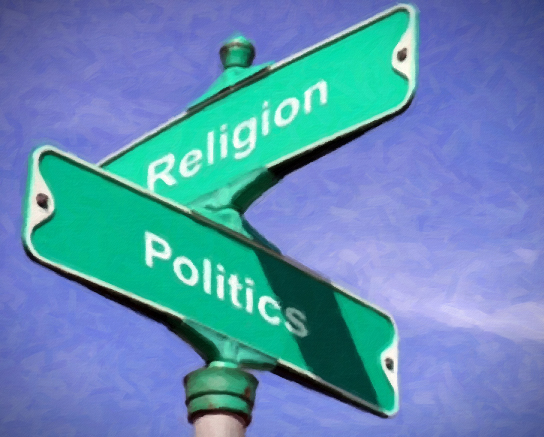
Democracy, Theocracy or Both? The Politics of Cheon Il Guk

Religion and Politics Artistic

By Michael Mickler

Mickler full-sizeMore than 20 years ago, in an unofficial Unification publication titled Currents (Fall 1989), Bruce Casino asserted that Unificationists hold four distinct positions on democracy:

  1. Some members, he said, believe that a republican democratic form of government is required in God’s ideal.
  2. Other members believe God alone knows what the ultimate political system is, but democracy is the best way to get there and is certainly the political system God wants at present.
  3. A third group believes a democratic, constitutionally limited monarchy after the British model is the ideal.
  4. A final group believes the ultimate goal is a non-democratic monarchic feudalism patterned after the movement’s internal polity — the “Korean kingdom” approach.

Casino argued that “close examination of fundamental Unification concepts leads inescapably to the conclusion that democracy is mandated by the religious doctrine of the Unification movement.”

He went further, stating that Unification religious tenets “support a republican, democratic system modeled after the American constitutional system, with elected representatives and a separation of powers between legislative, executive and judiciary.”

What the movement sought, he contended, was not to alter the republican, democratic system, but to focus it on “higher ideals,” a “greater spirituality” among citizens, a stronger sense of community, and to combat immorality, materialism, and racism.”

The question is whether Casino’s conclusions apply in the Cheon Il Guk (CIG) era.

Continue Reading→

Lead, Follow, or Get Out of the Way

arrow-road

By John Redmond

JohnRedmond2On the first anniversary of Foundation Day, Sam Nagasaka, project manager of the Vision 2020 Project of FFWPU International, presented in Today’s World a strategic planning document. It describes a process that each nation and city can follow to align their efforts with the current highest providential priority. Mr. Nagasaka (UTS class of 2000) served as a vice president for PR and marketing with World CARP International HQ and was part of the strategic task force team of Japan FFWPU HQ.

His document represents a significant change in the way strategic activities are developed in the movement.  Reverend Moon closely controlled strategic and tactical planning, seeking to move quickly and decisively, planning battles like a general, with short timelines and sacrificing long-term goals for short-term wins.  Based on his successful foundation, the shift to building and maintaining the movement for long-term effectiveness requires a different approach.

Mrs. Hak Ja Han Moon has set large general goals, but expects the central blessed families to take the time and make the effort to plan and execute strategies and tactics for success in the areas of their local and national responsibilities.  Headquarters can’t effectively decide what your community does best and how to make a community that attracts young families; only those who know the local area and culture can be successful at that.

Continue Reading→

Can an Organization Stay Great without Its Visionary Leader?

steve_jobs_by_subhraj1t-d4l06mu -2_edited-1

By Mark P. Barry

Mark Barry Photo 2Last June, in “Lessons from Apple under Steve Jobs,” I suggested what Unificationists could learn from the experience of Apple under its founder. Nine months later, and two and a half years since Jobs’ passing, Apple is facing more skeptics than at any point since its turnaround 16 years ago.

Now, many are asking whether Apple without Jobs can continue to make transformational products that will delight users. The reason is nothing Apple has introduced since fall 2011 — when Jobs died — has been innovative or disruptive, but simply modest improvements of existing products.

Has Apple lost the essence of what made it great? Is it struggling to find new vision and identity after Jobs? And what can we learn from its current experience as Unificationists?

In the business world, two and a half years is generally not sufficient time to make any judgments — except in the world of high technology, where new products are constantly introduced, superseded, disposed, and market share frequently shifts.

Continue Reading→

Giving, Freedom and the Future

ph_2046_1296296702

By Richard A. Panzer

Richard_PanzerIt could be fairly said the defining element of those who identify with the Unification Movement is that at one time or another in our lives, we have been touched by the teachings of Rev. and Mrs. Sun Myung Moon. Reflecting on Father’s legacy, I have asked myself what is the core message he strove to leave behind? If I had to choose one word to describe Rev. Moon, what would that be?

For me, that one word would be: giving. To pick just two of countless times: his 14 hours of non-stop speaking about God’s nature, will and ideal I experienced in the 1980s at Belvedere; and when he returned during temporary releases from Danbury prison and spent that time telling us not to worry, that God would use his incarceration to further bless America. The main lesson, in my mind, was: here is a man who is constantly striving to find ways to give more and more.

While he was battling his federal court case in 1982, he launched The Washington Times, and in 1984, purchased 250 trucks to be used to deliver food to the needy shortly before entering prison. How many foreigners in the U.S. decide, while on trial or in prison, to spend more than a billion dollars of precious resources to serve the nation that incarcerated them?

Continue Reading→

The Seven Principles of Creation

Blue metal compass

By Stephen Stacey

Stacey copy_edited-1What does it mean to apply the Principle to life? Does it mean that we just understand that the world has the potential to be much more ideal than it is, and then go off and read the ideas of others who are succeeding in life? Or does it mean that within the Principle itself, and in the many speeches of Rev. Moon, there lie the principles upon which human beings can succeed in building a more beautiful world into the future.

For the last 10 years, because of my teaching work, I have had to ask this question every day. Over time, I believe I have gained new insights into how both the Principle and principle-related concepts are helpful in understanding human well-being and success.

My first deep insight was a revelation I received at 2 a.m. on a bus to Russia where I was to teach a marriage enrichment seminar eight years ago. Let’s start with a simple scenario.

If you were the head of a project team at work, what questions might you ask to be sure the project was on track? Some of your most important questions might be:

Continue Reading→

The Economic System in Cheon Il Guk

world-economy

By Hideyuki Teshigawara

Teshigawara_edited-1As far as I know, there is no one who can explain the concrete system of Cheon Il Guk. But then is it possible to realize something without any clear vision and goal? Even if we have a clear vision and goal, it may be difficult to realize Cheon Il Guk.

Obviously, Cheon Il Guk is not the nation that can automatically be built by God’s miraculous power. The ideal of interdependence, mutual prosperity and universally shared values should be established through cooperation between God and human beings. It is wrong to think that the concrete plan for the society of Cheon Il Guk would be given by Rev. Moon or God unilaterally.

Regrettably, even inside the Unification Movement, a large number of people are reluctant to establish a concrete system for Cheon Il Guk. Their main insistence is that if the ideal world consists of “original” people (persons without fallen nature) and ideal families, the external structure will not be so important. However, it is a naive way of thinking that “original” people will do well whatever the system.

Continue Reading→

Website Built with WordPress.com.

Up ↑